Quick answer: Walk-in coolers and commercial freezers usually give warning signs days or weeks before they fail. Watch for slow recovery after the door opens, heavy frost on the evaporator coil, ice around the door frame, water on the floor, and a compressor that rarely shuts off. In Midland, TX, summer heat and dust make every one of these problems develop faster.
Main Points Covered in This Article
- Why Midland heat and dust push walk-ins harder
- 8 warning signs that show up before a walk-in fails
- What a warm box means under Texas food rules
- Checks your staff can do this week
- How GenMech HVAC finds the root cause
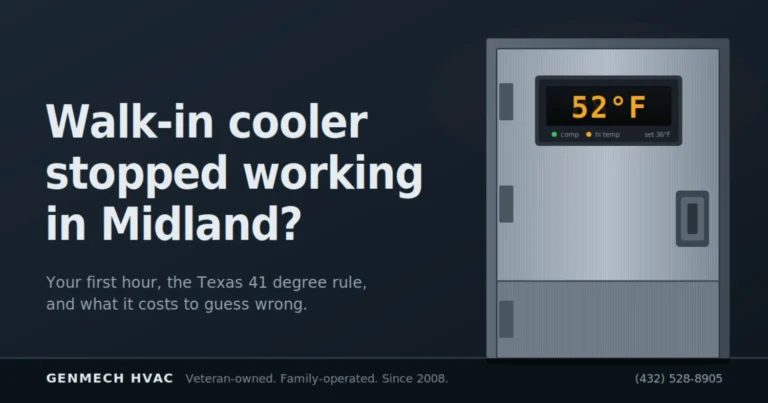
For a convenience store, grocery, restaurant, or catering operation in Midland, the walk-in is the equipment nobody thinks about until the morning the temperature log reads 48°F. At that point the problem is bigger than a repair. It becomes a product decision, a health inspection risk, and a scramble to move inventory before it is lost. Walk-in systems rarely fail without warning. The signs are there. They are just easy to miss during a busy shift.
Why Walk-Ins Work Harder in Midland
A walk-in cooler does not create cold. It moves heat out of the box and dumps it through the condensing unit. When that condensing unit sits on a rooftop or behind a building on a 105°F July afternoon, it is rejecting heat into air that is already hot. Head pressure rises, the compressor runs longer, and every component works closer to its limit.
Then there is the dust. Permian Basin wind carries fine caliche and field dust that packs into condenser coil fins. A coated coil cannot release heat, so the system runs longer to hold the same temperature. Add the early morning rush when field crews stock up on ice and drinks, plus afternoon deliveries of warm product, and a Midland walk-in sees far more heat load than the same box in a mild climate.
8 Warning Signs Your Walk-In or Commercial Freezer Is Struggling
Here is a quick reference before we go through each sign in detail.
| Warning sign | What it usually points to |
|---|---|
| Slow recovery after the door opens | Dirty coils, weak evaporator fan, slow refrigerant leak |
| Compressor runs nonstop or short cycles | Warm air infiltration, control problem, low charge |
| Thick ice on the evaporator coil | Defrost heater, defrost timer, or termination thermostat failure |
| Ice or sweat at the door frame | Worn gasket, sagging hinges, failed door frame heater |
| Water or ice on the floor | Clogged condensate drain line or failed drain line heater |
| Hot, loud, or dusty condensing unit | Dirty condenser coil, failing condenser fan, high head pressure |
| Temperatures creeping up over weeks | Refrigerant leak |
| Rising electric bill | Longer run cycles from any of the problems above |
1. The Box Takes Longer to Recover After the Door Opens
After a delivery or a restock, a healthy walk-in pulls back down to setpoint fairly quickly. If recovery that used to take a short while now takes much longer, the system is losing capacity. Dirty coils, a weak evaporator fan motor, and a slow refrigerant leak are the usual suspects.
2. The Compressor Runs Nonstop or Cycles On and Off Rapidly
A compressor that never shuts off is telling you the box cannot reach temperature. One that clicks on and off every few minutes, known as short cycling, often points to warm air leaking in, a control problem, or low refrigerant charge. Both patterns wear out contactors and shorten compressor life.
3. Thick Frost or Ice on the Evaporator Coil, Ceiling, or Fan Guards
A thin, even layer of frost between defrost cycles is normal in a freezer. A solid block of ice is not. Heavy icing usually means the defrost system is failing, whether that is a burned out defrost heater, a stuck defrost timer, or a bad termination thermostat. Ice forming on the ceiling or fan guards can also point to a defrost cycle that runs too long or a fan delay that is not working.
4. Ice or Sweat Around the Door Frame
Frost along one edge of the door, condensation on the frame, or a door that no longer pulls shut tells you warm, humid air is getting in. Torn or flattened door gaskets, sagging hinges, and missing strip curtains are common causes. On freezers, a failed door frame heater lets ice build up until the door will not seal at all.
5. Water on the Floor or Ice Under the Evaporator
Melt water from each defrost cycle has to drain out of the box. When the condensate drain line clogs, or the drain line heater in a freezer fails, that water backs up, spills onto the floor, or freezes into a ramp of ice under the coil. It is a slip hazard for staff and a sign the unit needs attention.
6. The Condensing Unit Outside Is Loud, Hot, or Caked With Dust
Walk around back and look. A condenser coil covered in dust, a condenser fan that wobbles or squeals, or a unit that is too hot to stand near are all signs of high head pressure. New grinding, rattling, or humming sounds from the compressor or fan motors mean something mechanical is under stress.
7. Temperature Logs Creep Up Slowly
A cooler that drifts from 36°F to 38°F to 40°F over a few weeks is easy to overlook because it never crashes. That slow climb is a classic refrigerant leak pattern. Oil stains near fittings, a hissing sound along the refrigerant lines, and a box that needs a refrigerant top off every season all point the same way.
8. Electric Bills Rise Without More Business
Refrigeration is often one of the largest electrical loads in a convenience store or small grocery. When the bill climbs and store traffic has not changed, a walk-in running longer cycles is a strong candidate.
Seeing one of these signs right now? A GenMech HVAC technician can check your walk-in, show you what is causing it, and explain your options before any work begins.
What Waiting Costs a Midland Business
The Texas Food Establishment Rules require time and temperature controlled foods to be held at 41°F or below, and frozen food must stay frozen hard to the touch. If an inspector finds that food has been above 41°F for more than four hours, the expected corrective action is to discard it. A walk-in running a few degrees warm is not just a maintenance issue. It is inventory, compliance, and reputation on the line.
The equipment pays a price too. A compressor forced to run against an iced coil or a dust covered condenser for months is headed toward a much larger failure than the small repair that would have caught it early.
Simple Checks Your Staff Can Do This Week
- Log box temperature at set times each shift using a calibrated thermometer, not only the wall display.
- Close the door and check that it seals. Light showing around the gasket means air is leaking.
- Keep product stacked away from the evaporator fans so air can circulate.
- Keep boxes, trash, and weeds clear of the outdoor condensing unit.
- Never chip ice off the coil with a tool. It punctures tubing and creates a refrigerant leak.
- Photograph frost patterns or water on the floor and note the time. It speeds up diagnosis.
Anything involving refrigerant or electrical components belongs to a licensed refrigeration technician. Refrigerant handling also requires EPA Section 608 certification.
How GenMech HVAC Diagnoses and Fixes Walk-In Problems
The most common complaint we hear from Midland operators is that a previous vendor added refrigerant, left, and the box was warm again a month later. Adding refrigerant without finding the leak is not a repair. Our commercial refrigeration service starts with the root cause.
We review your temperature logs and photos, then take real readings: suction and discharge pressures, superheat and subcooling, compressor amp draw and voltage, and evaporator airflow. We test the defrost timer, defrost heaters, termination thermostat, door frame heaters, and drain line heater, and we inspect the condenser coil and door gaskets. You get a clear explanation of what we found, with photos and readings, and your options before any work begins. After the repair, we verify the box pulls down and holds temperature.
Walk-ins rarely fail in isolation. A self-contained unit sitting in a back room cooled by a struggling rooftop unit is fighting extra heat all day. Because our technicians handle the full range of commercial HVAC services in Midland, we look at the whole building, and if a rooftop unit is part of the problem, our commercial HVAC repair team can address it as part of the same service plan.
For businesses that want fewer surprises, a maintenance agreement puts condenser coil cleaning, gasket inspection, and defrost verification on a regular schedule. If your walk-in has already stopped holding temperature, our guide to the first hour after a walk-in cooler goes down walks through what to do right away.
Frequently Asked Questions
How often should a walk-in cooler be serviced in West Texas?
Quarterly inspections suit most Midland businesses. Walk-ins with condensing units exposed to heavy dust may need condenser coil cleaning more often, especially through the summer.
Is ice on my walk-in freezer evaporator coil normal?
A thin, even frost between defrost cycles is normal. Thick ice that stays after a defrost cycle, or ice spreading to the ceiling and fan guards, points to a defrost, airflow, or door seal problem.
What temperature should a walk-in cooler hold in Texas?
Texas rules require time and temperature controlled food at 41°F or below. Many operators set their coolers a few degrees lower for a safety margin. Frozen food must stay frozen hard to the touch.
Can low refrigerant just be topped off?
Refrigerant does not get used up. If a system is low, it has a leak. Topping it off without locating and repairing the leak means the problem will return, usually during the hottest week of the year.
Catch the Warning Signs Before Summer Does
A walk-in that recovers slowly, ices up, sweats at the door, or runs all day is asking for attention now, while the fix is still small. GenMech HVAC is a veteran-owned, family-operated commercial HVACR contractor in Midland, TX, backed by more than 30 years of combined technician experience. Call (432) 528-8905 or request a commercial refrigeration assessment, and we will tell you exactly what we find and what it will take to fix it.