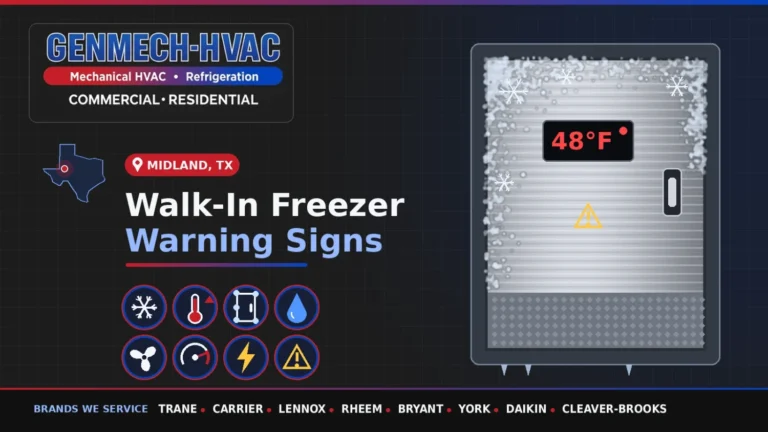
It usually happens at the worst possible time. A property manager takes a 7 a.m. call about a tenant space off Loop 250 where the walk-in is sitting at 52 degrees. A convenience store owner on Andrews Highway finds the beer cave warm and the case fans still turning. A facility manager walking a building on Wall Street notices the display case pulling frost in the wrong place. Nothing is leaking, nothing is smoking, and the unit is still humming. It just is not cold.
Most articles about this answer the wrong question. They tell you why refrigeration fails. If you are standing in front of a warm cooler right now, you do not need a cause. You need to know what to do in the next sixty minutes, what Texas rules say about the product on those shelves, and what it will cost you to guess wrong.
This guide is written for Midland, TX, property managers, facility managers, and retail business owners. It covers the first hour, the Texas Food Establishment Rules that decide whether a product is salvageable, the local conditions that make refrigeration fail harder here than the equipment manuals assume, and how to decide between a repair and a replacement without losing another week of trading.
The First Hour: What to Do Before Anyone Arrives
What you do in the first hour decides how much of this becomes a repair bill and how much becomes a loss. Work through these in order.
Take a Product Temperature and Write It Down
The number on the door display is the air temperature, and air warms long before the product does. Put a calibrated probe into an actual product, ideally something dense in the middle of the box, and record that reading with the time next to it. Take a second reading thirty minutes later.
Those two numbers are the most valuable thing you will produce today. They tell a technician how fast the box is losing ground, they tell your insurer what happened, and if a health inspector walks in tomorrow, they are the difference between a documented response and a guess.
Keep the Doors Shut
The instinct is to open the door and look. Every time you do, you dump the remaining cold air onto the floor and pull warm air back into the box. A loaded walk-in with the door closed holds usable temperature far longer than an empty one that gets opened every ten minutes. Decide what you need, get it out in one trip, and close it.
Check the Three Things That Are Not a Service Call
A small share of failures are not failures at all. Before you call anyone, check these:
- The breaker and the disconnect. Condensing units often sit on a separate circuit from the lights inside the box, so the light can work while the compressor has no power.
- The controller setpoint. Setpoints get bumped, and they get changed during a defrost troubleshoot and never put back.
- Airflow inside the box. A delivery stacked against the evaporator coil or a case loaded above the load line will starve the return air and warm the whole box.
Stop there. Anything past those three, including anything involving refrigerant, electrical components, or a compressor that will not start, needs a certified technician. It is not just a safety matter. It is a legal one.
Start the Clock
Note the time you first found the problem. Note it in writing. The next section explains why that single timestamp may be worth thousands of dollars of inventory.
What Texas Rules Say About the Product in a Warm Cooler
This is the part almost no local refrigeration page will tell you, and it is the part that actually decides your losses.
Under the Texas Food Establishment Rules, cold time and temperature control for safe food, often called TCS or potentially hazardous food, must be held at 41 degrees Fahrenheit or below. Dairy, deli, packaged meat, cut produce, and prepared foods all fall under that requirement, which is why this matters to any tenant space or retail floor holding chilled product, not just to kitchens.
When a cooler stops holding temperature, the general rule works out like this:
- TCS food that has been above 41 degrees for less than four hours can generally be rapidly cooled back down and kept.
- TCS food above 41 degrees for more than four hours is subject to voluntary destruction.
That four-hour line is why the timestamp matters. If you can show when the failure started and what the product temperatures were, you get to make a defensible call about what to save. If you cannot, the conservative answer is to discard, and the conservative answer is expensive.
Loss of Refrigeration Is Treated as an Imminent Health Hazard
Texas inspection practice treats certain conditions as imminent health hazards, meaning the operation closes until the hazard is corrected and the regulator approves reopening. Loss of refrigeration sits on that list, alongside loss of power, loss of potable or hot water, and sewage backup.
In practical terms, a box that cannot hold 41 degrees is not only a product loss. If an inspection lands while the equipment is down and there is no working backup cold storage, you are looking at a possible closure on top of it. For a landlord or property manager, that is a tenant who cannot trade, which becomes your problem quickly.
Who Regulates This in Midland
Food establishments in Midland are permitted and inspected by the City of Midland Health Department Environmental Health Section, which covers both city and county limits. The office is at 3303 W. Illinois, Suite 22, and can be reached at (432) 681-7613 or environmentalservices.
If you are working through a significant temperature event and you are unsure what has to be discarded, calling them is not an admission of anything. It is the documented, defensible path, and it is a much better position than being asked later why nothing was recorded.
Why Midland Is Harder on Refrigeration Than the Manual Assumes
Commercial refrigeration equipment is rated under conditions most of the country experiences. The Permian Basin is not most of the country, and three local factors change the math.
Ambient Heat That Derates the Whole System
National Weather Service records for Midland put the average July high at 95.8 degrees, with a July record of 112 degrees set on July 2, 1989. A condensing unit has to reject heat into that air. The hotter the air around the condenser, the higher the head pressure, the longer the run times, and the less capacity the system actually delivers.
This is why a marginal system limps through winter and fails in July. It was never fixed in November. It simply was not being asked for full output. A rooftop condenser on a west facing wall in August is operating in air well above the ambient the equipment was sized around.
Permian Basin Dust on the Condenser Coil
Wind blown caliche dust is the single most underrated cause of refrigeration failure in this region. It mats into the condenser fins, and a fouled condenser does exactly what high ambient heat does: it drives head pressure up and capacity down, and it works the compressor harder every hour it runs.
A condenser cleaning schedule that is adequate in Dallas is not adequate in Midland. High traffic retail sites with roof mounted or alley mounted condensers generally need cleaning far more often than the annual visit most operators default to.
Summer Grid Stress and Power Quality
Late afternoon voltage sags, brief outages during summer storms, and the hard restarts that follow are rough on compressors and contactors. A unit that was already carrying a weak capacitor or pitted contacts often does not survive the restart. If your cooler went down right after a power blip, tell the technician. It narrows the diagnosis immediately.
What Downtime Actually Costs a Midland Business
Operators tend to price this as the repair invoice. The repair invoice is usually the smallest number on the list. The real cost stacks up in four layers:
- Product. Discarded inventory at replacement cost, not at cost of goods you had already written down.
- Lost revenue. A cooler line roped off through a weekend, or a tenant who cannot open at all.
- Labor and logistics. Staff hours spent moving product, renting or borrowing cold storage, and restocking afterward.
- Reputation. In a market the size of Midland, a weekend of empty cases travels fast.
One more layer applies if you intend to file a claim. Spoilage coverage almost always requires proof of the failure and proof of the temperatures. Photographs of the product probe reading, the controller display, the timestamped log, and the technician’s repair invoice are the evidence. Collect them while the event is happening, because reconstructing them afterward rarely works.
What Different Midland Businesses Are Actually Losing
Refrigeration failure does not look the same across every building in town.
Commercial Property and Facility Managers
The widest exposure, because the equipment is rarely yours but the phone call always is. A single failure can involve a tenant losing stock, a lease obligation about who maintains what, and a building system nobody has documented since it was installed. The managers who handle this well have three things ready before anything breaks: an equipment list with model and serial numbers, a service history, and a standing contractor who already knows the site. Without those, the first hour is spent identifying equipment instead of fixing it.
Convenience Stores and Grocery
Multiple independent systems, which means partial failures are common and easy to miss. A beer cave, a glass door cooler line, an open dairy case, and an ice machine can each fail on their own. Store staff are usually watching the sales floor, not case temperatures, so a drifting case often goes unnoticed until product is already out of spec. The fix is boring and effective: a written temperature round, once a shift, on every case.
Restaurants and Bars
The tightest clock, because the four hour rule governs everything and prep is already in motion when the problem is found. Worth being clear about scope here: GENMECH services the refrigeration side, meaning walk-in coolers and freezers, reach-ins, display cases, and ice machines. Cooking equipment is a separate trade and a separate call.
Caterers, Food Trucks, and Oilfield Catering
No slack in the schedule. Product is staged for a specific event or a specific crew change, and there is no second cooler to move it to. Cold chain documentation matters here more than anywhere, particularly for remote site feeding across Midland County and out toward Stanton and Greenwood.
Florists and Specialty Retail
Different rules, same equipment. A floral cooler holding the wrong temperature ruins an entire wedding order with no way to replace the stock locally on short notice. The health code does not apply, but the inventory value per cubic foot often exceeds what a food cooler is holding, and the product has no salvage value once it turns.
What a Technician Will Actually Do
Knowing the sequence helps you tell a real diagnosis from a parts swap. A competent commercial refrigeration call generally runs in this order:
- Confirm power, controls, and safety lockouts before touching the refrigerant circuit.
- Read suction and discharge pressures, superheat, and subcooling, and compare them against the design conditions for that equipment at today’s ambient.
- Inspect the condenser and evaporator for fouling, ice, and fan failure.
- Verify the defrost cycle, termination, and drain line, since a blocked drain in a freezer becomes an ice problem that looks like a refrigerant problem.
- Check electrical components under load, including capacitors, contactors, and compressor amp draw.
- Leak search before adding any refrigerant.
Why “Just Top It Off” Is Not an Answer
A system low on refrigerant has a leak. Refrigerant is not consumed. Adding a charge without finding the leak buys a few weeks and sends the same money out through the same hole.
On larger systems it is also a federal compliance issue. EPA Section 608 rules apply to appliances with a full charge of 50 pounds or more. Commercial refrigeration equipment at that size has a 20 percent annual leak rate trigger, repairs must be initiated within 30 days of exceeding it, and systems from 50 to 500 pounds require annual leak inspections, with quarterly inspections above 500 pounds. If you manage a supermarket rack or a large multi-box system, your service records are part of your compliance file, not just your maintenance history.
When you need emergency commercial refrigeration repair in Midland, TX, ask whether the technician will document pressures, superheat, and leak search results. A company that writes those numbers down is a company you can hold to a diagnosis.
Repair or Replace: Making the Call Under Pressure
You will be asked to decide this while you are already down, which is the worst time to think clearly. A few reliable signals:
Repair is usually the right call when the failure is a single component such as a fan motor, capacitor, contactor, defrost control, or expansion valve, the cabinet and insulation are sound, and the system has not had repeated refrigerant losses.
Replacement deserves serious consideration when the compressor has failed on a system already past its expected life, when there have been multiple leak repairs on the same circuit, when the box panels are waterlogged or delaminating, or when the equipment runs a refrigerant that is being phased down and is getting expensive and hard to source.
One Midland specific consideration: replacement equipment for commercial refrigeration is frequently not sitting on a shelf in the Permian Basin. Lead time on a matched condensing unit or a custom walk-in panel set can stretch into weeks. If replacement is even a possibility, start pricing and ordering while the repair is being done, not after.
Making Sure There Is No Next Time
Almost every emergency refrigeration call in Midland traces back to something that was visible weeks earlier: a condenser packed with dust, a gasket that stopped sealing, a defrost cycle that was never verified, or a temperature that had been drifting and recovering for a month. For a closer look at those patterns and how they build, read why Midland refrigeration keeps failing.
Two habits prevent most of it. First, log product temperatures daily, in writing, on every box you depend on. A log turns a sudden failure into a trend you saw coming, and it doubles as your compliance record. Second, put condenser cleaning and refrigeration inspection on a fixed schedule sized for West Texas dust rather than a generic national interval. Managers who want that handled without tracking it themselves can fold it into an HVAC maintenance agreement covering their refrigeration equipment.
FAQ
My walk-in cooler stopped working. What should I do first? Take a product temperature with a calibrated probe, write it down with the time, and keep the doors closed. Then check the breaker and disconnect, the controller setpoint, and whether anything is blocking the evaporator. If none of those explain it, call a commercial refrigeration technician and stop there.
How long can product stay in a cooler that is not running before it has to be thrown out? Under the Texas Food Establishment Rules, cold TCS food must be held at 41 degrees Fahrenheit or below. Food that has been above 41 degrees for less than four hours can generally be rapidly cooled and kept. Beyond four hours it is subject to voluntary destruction. Your timestamped temperature log is what makes that call defensible.
Can a broken cooler get a Midland business closed by the health department? It can. Loss of refrigeration is treated as an imminent health hazard in Texas inspection practice, which means an operation can be closed until the hazard is corrected and the regulator approves reopening. Midland food establishments are inspected by the City of Midland Health Department Environmental Health Section at (432) 681-7613, covering city and county limits.
Why does my cooler fail every summer but run fine in winter? Because summer is the only time it is asked for full capacity. With an average July high of 95.8 degrees in Midland, a condenser fouled with Permian Basin dust or a system slightly low on charge still holds temperature in January and cannot in July. The fault existed the whole time. The heat only revealed it.
My technician says he cannot just add refrigerant. Why? Refrigerant is not used up, so a low system has a leak. Recharging without repairing it wastes the charge and the money. On appliances with a charge of 50 pounds or more, EPA Section 608 also sets a 20 percent annual leak rate trigger for commercial refrigeration and requires repairs to be initiated within 30 days of exceeding it.
Is it worth repairing an older walk-in or should I replace it? Repair single component failures on a sound cabinet. Consider replacement after a compressor failure on aging equipment, after repeated leak repairs on the same circuit, or when the panels are waterlogged. In the Permian Basin, factor in lead time, since matched condensing units and custom panels often are not stocked locally.
Who is responsible for the cooler in a leased space, the landlord or the tenant? That depends entirely on the lease, and it is worth reading before an emergency rather than during one. What matters operationally is that somebody has the equipment list, the service history, and a contractor who knows the site. Deciding that at 7 a.m. with warm product on the shelves costs hours you do not have.
Will insurance cover the spoiled product? That depends on the policy, but spoilage coverage generally requires proof of the equipment failure and proof of the temperatures. Photograph the probe reading and the controller display, keep your timestamped log, and keep the technician’s invoice showing the diagnosis and repair.
How fast can someone get to me in Midland? Response depends on when the call comes in. Morning calls generally get same-day dispatch, and late-day calls get first thing the next morning. When you call, have your equipment type, the product temperature, the time the problem started, and whether anything changed recently, such as a power blip or a recent service visit.
Get the Box Back to Temperature
GENMECH HVAC services commercial refrigeration for property managers, retail centers, convenience stores, grocers, and food service operators across Midland, Odessa, and the wider Permian Basin and has done so since 2008. We are veteran-owned and family-operated, and we document what we find so you have the numbers your inspector and your insurer are going to ask for.
If a cooler, freezer, display case, or ice machine is losing temperature right now, call (432) 528-8905.