If you have lived in Midland for more than one summer, you already know the routine. You wipe down a windowsill on Saturday, and by Tuesday there is a fine tan film back on it. That same dust does not stop at your windowsill. It gets pulled through your return vents, past your filter, and across your evaporator coil, and it settles on every surface inside your air conditioning system.
Most homeowners think of dust as a cleaning problem. Mechanically, it is a heat transfer problem, and that one is considerably more expensive
.
Why Permian Basin Dust Is Different
Not all dust behaves the same way inside an HVAC system. What blows across West Texas is a mix of caliche fines, gypsum, quartz sand, and clay particles lifted off open ground, unpaved lease roads, and cleared lots. Two properties matter here.
The first is particle size. A meaningful share of what lands in your system falls below 10 microns, which is small enough to pass straight through a low-rated pleated filter and keep going into the equipment.
The second is composition. Household dust in a humid climate is mostly skin cells, fabric fiber, and pollen. It is soft and organic. Caliche fines are crushed limestone. They are abrasive and mineral-heavy, and they do not break down. On a coil surface they build a dense layer that behaves more like a coating than a fuzz, which is exactly the wrong behavior for a surface whose entire job is to move heat.
Then add the wind. Spring in the Permian Basin regularly runs sustained wind well past what most of the country deals with, and every one of those days pushes airborne particulate directly into the outdoor section of your system.
Where Dust Collects Inside Your AC System
Dust does not distribute evenly through the system. It concentrates in four places, and each one fails in its own way.
The condenser coil
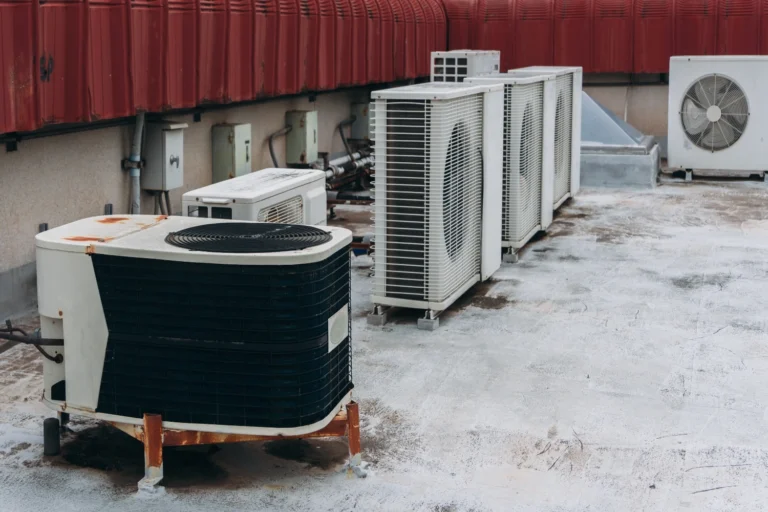
This is the outdoor unit. Its job is to reject heat from the refrigerant into outside air, which means a fan pulls a large volume of unfiltered outdoor air straight through the coil fins. Every particle in that air stream has a chance to lodge between the fins. Over a season or two you get a packed mat across the coil face, and a dirty condenser coil is one of the most common conditions our technicians find on a first visit to a Midland home.
The evaporator coil
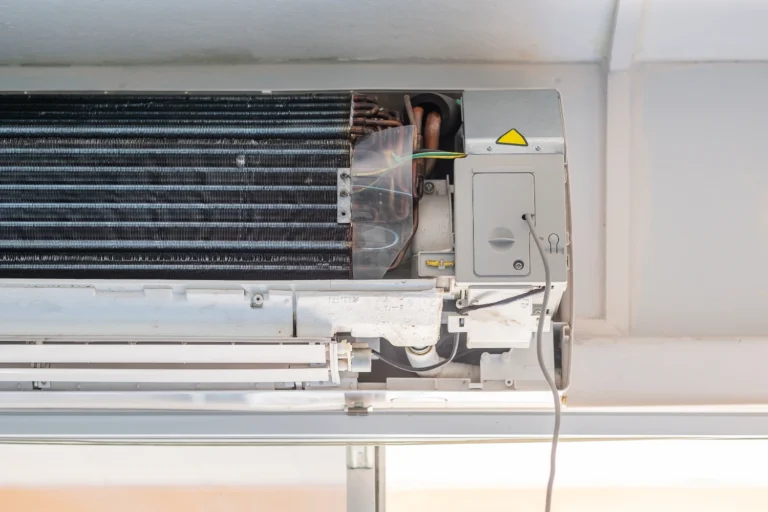
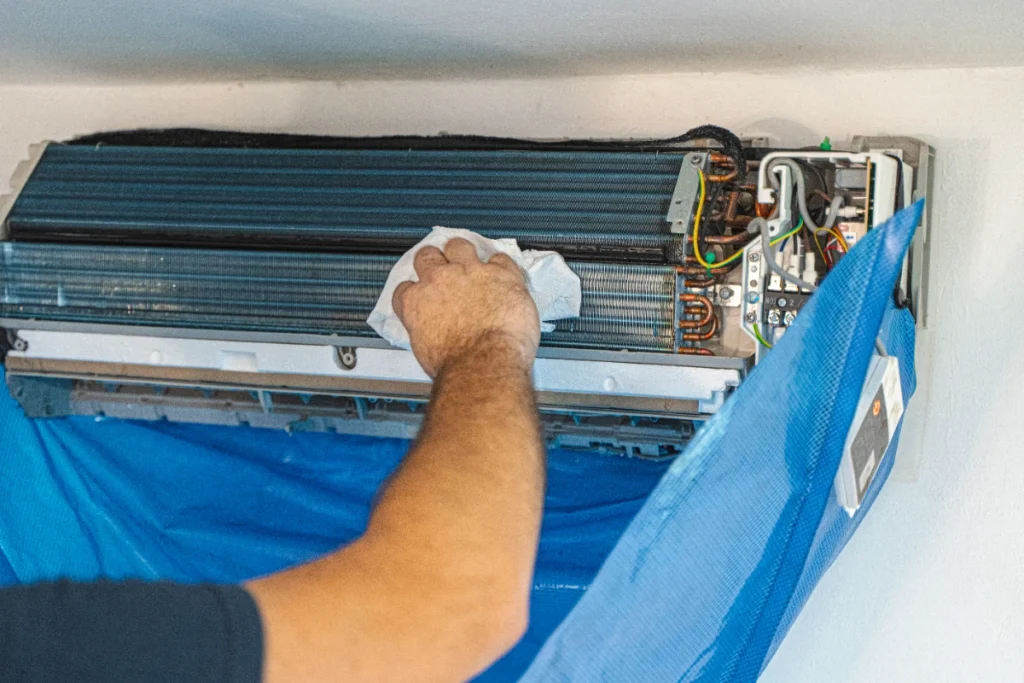
On the indoor side, usually sitting in the air handler above or beside your furnace. This coil runs cold and wet during cooling season, so any dust that clears the filter arrives at a damp surface and sticks to it. Evaporator coil dust buildup is harder to catch because the coil is enclosed and nobody sees it, and it is harder to correct because the fin surface is delicate and the access is tight.
The air filter
The filter is doing exactly what it was designed to do, which is why it loads so quickly in this climate. A clogged air filter full of dust stops catching new particles, and more importantly, it starts restricting airflow through the entire system.
The blower wheel
Rarely discussed and often the worst offender. The blower wheel has curved blades, and fine dust packs into the concave side of each one. A loaded blower wheel moves noticeably less air even with the motor running at full speed, and because the motor sounds normal, homeowners almost never suspect it.
How Dust on AC Coils Reduces Efficiency
An air conditioner does not create cold. It is a heat transfer machine that moves heat from inside your house to outside, and it does that work at two coils. Anything sitting between the metal and the air is insulation, and insulation is the exact opposite of what a coil is for.
When dust coats a condenser coil, the refrigerant cannot reject heat efficiently. Head pressure climbs. The compressor works harder against that elevated pressure, draws more current, and runs hotter. Efficiency drops and component stress rises at the same time, which is a bad combination to leave running all summer.
On the indoor side, dust on the evaporator coil combined with a restricted filter drives static pressure up and airflow down. Less air moving across a cold coil means the coil gets colder than it was designed to run. Push that far enough and the coil temperature drops below freezing, condensate turns to ice, and the ice blocks airflow further. That feedback loop is what sits behind the familiar complaint of a system that runs all afternoon and never quite gets the house comfortable.
None of this presents as a breakdown at first. It presents as longer run times, a narrower temperature split between supply and return air, and a utility bill that creeps up without an obvious reason.
Warning Signs Your System Is Dust Loaded
- Your filter looks gray or tan well before you expected to change it
- The outdoor unit runs hot to the touch and the air coming off the top feels weaker than it used to
- You can see packed dust between the fins of the outdoor coil in daylight
- Supply air from the vents feels cool but not cold, and the house takes much longer to reach the setpoint.
- The system runs nearly continuously on hot afternoons
- Dust settles on furniture faster than it should, even while the system is running
Any one of these on its own is worth a look. Two or three together usually means the system has been fighting a restriction for a while and has been losing capacity the whole time.
What Midland Homeowners Can Do About It
A few things genuinely help in this climate, and a couple of the common instincts make things worse.
Change filters on a shorter interval than the packaging suggests. Manufacturer intervals are written for average conditions, and West Texas is not average. Many Midland homes need a monthly change during dust season rather than the printed 90 days.
Choose the filter rating deliberately. A higher MERV rating captures finer particles, which is what you want here, but it also creates more resistance across the filter face. Going too high on a system that was not designed for it trades a dust problem for an airflow problem. The right rating depends on your equipment and your duct design, not on what is on sale.
Keep the area around the outdoor unit clear. Aim for roughly two feet of clearance on all sides, and do not let shrubs grow into the coil. Outdoor AC unit debris such as cottonwood fluff, grass clippings, and blown trash compounds whatever the dust is already doing.
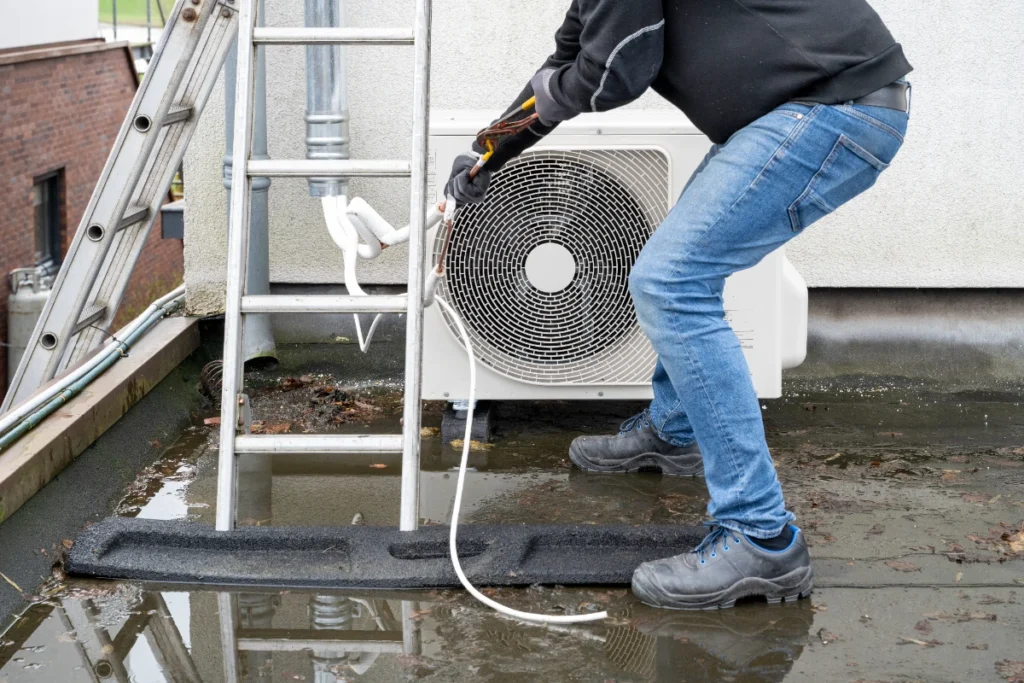
Rinse the condenser coil gently. Low pressure water from the inside out, with the electrical disconnect pulled first. Do not reach for a pressure washer. It will bend the fins flat and make the restriction permanent, which is a much harder problem to fix than the dust was.
Schedule professional cleaning ahead of peak season rather than during it. Coil cleaning, blower wheel service, static pressure checks, and condensate drain clearing are all part of seasonal HVAC tune-ups, and every one of them is easier and cheaper to handle as scheduled maintenance than as an emergency in August.
When Cleaning Is Not Enough
There is a point where dust stops being a maintenance item and becomes a mechanical problem. Sustained operation against high head pressure wears compressors. Restricted airflow shortens blower motor life. Fine abrasive particulate works its way into bearings. Dust packed against a wet condensate pan turns into sludge, blocks the drain, and puts water where it does not belong.
If your system is short cycling, tripping on high pressure, freezing up repeatedly, or showing a temperature split well outside the normal range, cleaning alone will not resolve it. At that stage you need AC repair and diagnostics with real instrumentation behind it, meaning refrigerant pressures, superheat and subcooling readings, static pressure measurements, and amp draw on both the compressor and the blower. Those numbers are what separate a dirty system from a charge problem, a failing component, or some combination of all three.
Frequently Asked Questions
How often should I change my air filter in a dusty area like Midland?
Most Midland homes do better on a monthly filter change through spring and summer than on the 90-day interval printed on the box. Pull the filter at 30 days and hold it up to a light. If light does not pass through it easily, it is finished. Homes near unpaved roads, open lots, or active construction usually need it changed sooner than that.
Does dust actually make an AC work harder, or is that just something contractors say?
It is measurable. Dust on a condenser coil raises head pressure, which shows up directly as increased compressor amp draw. Dust on the evaporator coil and a loaded filter raise static pressure and cut airflow. Both effects mean the system runs longer to reach the same temperature.
Can dust permanently damage an air conditioner?
Dust itself does not destroy components overnight, but the operating conditions it creates absolutely shorten equipment life. A compressor running for years against elevated head pressure fails earlier than one that is not. The damage comes from the conditions, not from the particles.
Why is my AC full of dust even though I have a filter installed?
Two reasons. Every filter has a rating, and particles finer than that rating pass straight through. On top of that, most residential duct systems have some leakage on the return side, so air drawn in from an attic or crawl space bypasses the filter entirely and goes right to the coil.
What happens if AC coils are left dirty?
Reduced cooling capacity, longer run times, higher energy use, and added stress on the compressor and blower motor. On the indoor side, a dirty evaporator coil combined with restricted airflow can ice the coil over, which stops cooling completely until it thaws.
Should I clean the coils myself or have it done?
The outdoor condenser coil can be rinsed carefully by a homeowner with a garden hose and the disconnect pulled. The evaporator coil and blower wheel are a different situation. Both are enclosed, both require partial disassembly to reach, and both are easy to damage with the wrong approach or the wrong chemical.
The Bottom Line for West Texas Homeowners
Permian Basin dust is not going anywhere, and no filter, cover, or maintenance schedule is going to keep it entirely out of your equipment. What you can control is how much of it accumulates before somebody removes it. A system that gets its coils cleaned, its filter changed on an interval that reflects this climate rather than a national average, and its airflow verified before summer will hold its capacity and run fewer hours than an identical system that does not.
If you are not sure where your system stands right now, the fastest check is the filter and the outdoor coil. If either one is loaded, the rest of the system has been working against that restriction for a while. GenMech HVAC has serviced homes across Midland and the Permian Basin since 2008, and dust-related capacity loss is one of the most common conditions our technicians document on a first visit. Homeowners looking for ongoing protection can also review our residential warranty coverage options.