When a walk-in cooler loses temperature on a Friday afternoon in July, the immediate problem is not the repair call. The immediate problem is what is sitting on those shelves. A restaurant carrying $8,000 in weekend inventory, a convenience store with a full cold vault, or a food distributor with a loaded walk-in freezer does not have the luxury of waiting until Monday morning for a technician to diagnose the system. The financial damage from spoiled product often exceeds the cost of commercial refrigeration repair by a significant margin, and in most cases the failure was not sudden. It was gradual, and it sent signals that nobody was watching for.
Operators searching for commercial refrigeration repair near me in the middle of a breakdown are already absorbing costs that a simple inspection would have prevented. This post covers what causes commercial refrigeration failure in Midland’s operating environment, the early warning signs that appear before a breakdown, and the maintenance habits that separate operators who catch problems early from those who absorb preventable losses.
Why Commercial Refrigeration Fails Faster in West Texas
The ambient conditions in Midland Place commercial refrigeration services equipment under sustained stress that operators in cooler climates do not face. Outdoor temperatures that push past 105 degrees from June through August force condensing units to work significantly harder to reject heat. A condensing unit designed to operate at an ambient of 95 degrees that is sitting on a rooftop or against a south-facing exterior wall in 110-degree afternoon heat is already operating outside its comfort zone before any maintenance deficit is added to the equation.
That thermal load pressure is constant during peak summer months. Compressors run longer cycles. Condenser fans operate at higher duty. Refrigerant pressures climb. Every component in the refrigeration circuit accumulates wear faster than it would in a temperature-controlled environment. The systems that hold up are the ones receiving regular refrigeration preventive maintenance. The ones that fail are the ones running on whatever condition they were in when the last technician left, regardless of when that was.
West Texas dust compounds the problem. Condenser coils that are not cleaned regularly develop a layer of particulate buildup that reduces airflow across the coil surface. Reduced airflow means reduced heat rejection. Reduced heat rejection means elevated head pressure. Elevated head pressure means compressor overheating warning signs appear, and the compressor works harder and runs hotter than it is designed to. That cycle does not reverse itself. It continues until something fails, and when it does, the cost of emergency commercial refrigeration repair dwarfs what routine service would have cost.
The Warning Signs Most Operators Notice But Do Not Act On
The single most consistent pattern in commercial refrigeration repair calls is this: the warning signs were present for days or weeks before the breakdown, but nobody connected them to a developing problem until the system stopped cooling entirely.
Temperature That Drifts and Then Recovers
A walk-in cooler or reach-in unit that holds its setpoint through the night but climbs two or three degrees above target during afternoon hours and then recovers overnight is not functioning normally. That pattern reflects a system struggling to keep up with the heat load during peak ambient conditions. It may indicate dirty coils, low refrigerant, a failing compressor, or a combination of those factors. The system recovers at night because ambient temperatures drop and the heat load reduces. It is not fixed. It is barely keeping up, and that margin gets smaller as the underlying condition progresses.
Operators who track box temperature consistently, even informally, catch this pattern before it becomes a failure requiring refrigeration repair by commercial technicians on short notice. This is one of the most overlooked early signals in walk-in cooler temperature loss situations.
Compressor Running Longer Than Usual
Every refrigeration system has a typical compressor duty cycle, which is the percentage of time the compressor runs relative to total operating time. A well-maintained system holds that duty cycle within a fairly consistent range. When the duty cycle increases without a corresponding change in how the equipment is being used, something in the system has changed.
Longer compressor runtime usually traces to heat-transfer problems. Condenser coil cleaning in commercial refrigeration is deferred, and the compressor runs longer to achieve the same heat rejection. Low refrigerant charge reduces system efficiency. A failing compressor runs longer to do work that a healthy compressor completes in less time. None of these conditions resolve on their own, and they are among the leading reasons operators end up scheduling commercial refrigerator repair under emergency conditions.
Ice Formation Where It Should Not Be
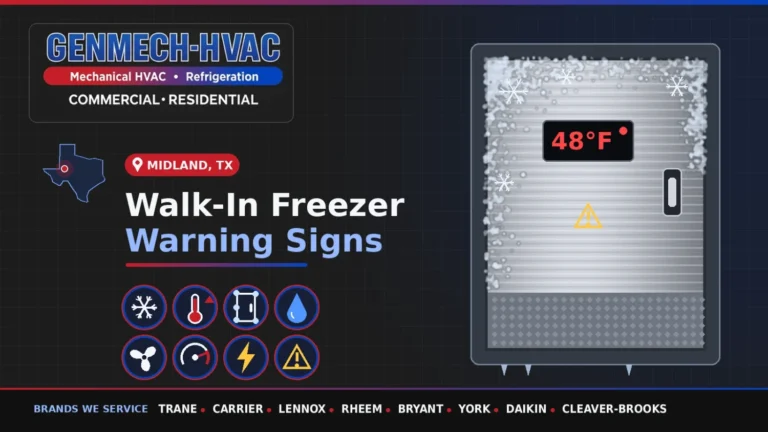
Ice buildup on evaporator coils inside a walk-in freezer is normal within the context of a functioning defrost cycle. Ice formation outside that pattern is not. Evaporator coil icing walk-in outside the defrost cycle, or ice on refrigerant lines outside the unit, signals an airflow restriction, a defrost system fault, or a refrigerant charge problem.
Running the system without addressing the cause allows the ice buildup to worsen until the evaporator is fully blocked and the unit stops cooling entirely. At that point the repair is more complex than it would have been at the first sign of abnormal ice formation. This is one of the primary walk-in freezer failure causes that preventive service catches before it compounds.
Unusual Compressor or Fan Noise
Refrigeration compressors and condenser fans have characteristic operating sounds. Any deviation, including new vibration, rattling, grinding, or a change in pitch during startup, is worth investigating immediately. Compressor noise typically indicates bearing wear, lubrication problems, or liquid slugging. Condenser fan noise usually points to blade imbalance, bearing failure, or motor winding deterioration. Neither improves without intervention, and waiting converts what would be a routine refrigeration repair call into a full component replacement.
Door Gaskets That Feel Soft, Torn, or No Longer Seal Cleanly
Walk-in cooler and freezer door gasket walk-in cooler condition is a maintenance item most operators defer longer than they should. A gasket that has lost its compression seal allows warm, humid outside air to enter the box continuously, raises the heat load, forces the compressor to run more frequently, and introduces moisture that accelerates ice buildup. In a walk-in freezer, a failed door gasket can be responsible for a 10 to 15 percent increase in commercial refrigeration energy costs and significantly shortened compressor service life.
The test is simple. Close the door on a piece of paper and pull it out. If the paper slides free without resistance, the gasket is no longer sealing effectively.
Energy Bills Climbing Without a Change in Usage
Commercial refrigeration is one of the largest contributors to a restaurant or Permian Basin food service operation’s utility bill. A gradual increase in monthly energy costs without a corresponding change in operating hours or units running is almost always a commercial refrigeration energy cost efficiency problem. Dirty coils, a failing compressor, a refrigerant charge issue, or a failing door gasket each contribute to increased energy consumption, and they often develop simultaneously.
What Commercial Refrigeration Midland TX Operators Are Getting Wrong About Maintenance
Most operators in the Midland market treat refrigeration service as a reactive expense. Something fails, they call for commercial refrigeration repair Midland service, they pay the repair invoice, and the cycle repeats. The pattern is predictable because the underlying equipment conditions that cause failures are also predictable, and they develop on a timeline that preventive maintenance interrupts.
The businesses that avoid repeat commercial refrigeration repair near me search cycles are the ones that have a documented service relationship with a qualified technician who visits on a schedule, not in response to a failure. The difference in annual maintenance cost versus reactive repair cost is substantial, and the operational disruption from unplanned downtime does not appear on any maintenance invoice because it never happens.
The Maintenance Tasks That Prevent Most Failures
Condenser Coil Cleaning
Condenser coil cleaning for commercial refrigeration is the most impactful single maintenance task for refrigeration systems operating in West Texas. In Midland’s dusty environment, condenser coils on rooftop or exterior condensing units can accumulate enough particulate buildup to meaningfully reduce airflow within a single season. Most commercial units in this region benefit from cleaning at a minimum twice per year, with locations near construction activity or open lots requiring more frequent attention.
Refrigerant Charge Verification
Refrigerant charge verification confirms that the system is operating with the correct amount of refrigerant and that no slow leak has developed since the last service visit. A refrigerant leak does not always announce itself. Small leaks develop over months and produce the gradual performance decline described above before they produce a fault condition. Checking refrigerant pressures and verifying subcooling and superheat values at each service visit identifies developing charge issues before they affect system performance or damage the compressor.
Defrost Cycle Inspection
A defrost cycle inspection of the walk-in freezer confirms that the defrost heaters, defrost termination thermostat, and defrost timer or controller are functioning correctly. A defrost system that is not completing its cycles allows ice to accumulate on the evaporator until airflow is blocked and the unit stops cooling. Verifying defrost cycle completion at each maintenance visit takes minutes and prevents one of the most common walk-in freezer failure causes.
Electrical Connection Inspection
Electrical connection inspection for refrigeration covers the contactor, capacitors, and wiring connections at the condensing unit. Loose connections generate resistance heat. Resistance heat at a compressor contactor or capacitor causes those components to fail prematurely and, in some cases, causes arcing that damages the compressor wiring. Tightening connections and testing capacitor microfarad values at each visit catches these issues before they produce an emergency commercial refrigeration repair call.
Door Gasket Inspection and Replacement
Walk-in cooler and freezer door gasket walk-in cooler inspection should be part of every maintenance visit. Gaskets have a finite service life, and their condition affects commercial refrigeration energy costs, compressor duty cycle, and interior humidity levels. Replacing a gasket before it fails completely is a minor expense. Replacing a compressor that accumulated premature wear hours because the box was never fully sealed is not.
What Refrigeration Downtime Actually Costs Midland Operators
The full cost of restaurant refrigeration downtime extends beyond the repair invoice. For a restaurant or food service operation in Midland, a walk-in cooler failure during a busy weekend involves the repair cost, the value of spoiled inventory, the labor cost of managing the crisis and disposing of unusable product, potential health code implications if the failure affects food safety refrigeration West Texas compliance,, and the reputational impact of being unable to serve the menu.
A mid-size restaurant carrying $5,000 to $10,000 in perishable inventory across refrigeration and walk-in units absorbs that inventory loss in addition to the commercial refrigeration repair bill when a failure occurs without warning. A convenience store refrigeration system losing a full cold vault of beverages and dairy during a summer weekend faces a similar calculation. Food spoilage prevention commercial maintenance is not a discretionary budget item. It is insurance against a loss category that no repair invoice captures in full.
The math on refrigeration preventive maintenance is straightforward. A twice-annual service visit that costs a few hundred dollars per unit prevents the category of failure that produces a $3,000 commercial refrigeration repair Midland bill plus a weekend of spoiled inventory. No operator who has been through an unplanned refrigeration failure questions the value of a maintenance agreement afterward.
Questions to Ask When Evaluating a Commercial Refrigeration Service Provider
Not every HVAC company in Midland has experience with commercial refrigeration equipment. Walk-in cooler systems, display case refrigeration service, ice machine performance restoration, and reach-in cooler maintenance are distinct from HVAC systems and require technicians who understand refrigerant management, defrost system logic, and food service equipment specifically.
When evaluating a commercial refrigeration service provider, ask whether their technicians have direct experience with the type of equipment in your facility. Ask whether they carry refrigerant and common refrigeration parts on service vehicles or whether parts need to be ordered before the repair can proceed. Ask what their response commitment is for refrigeration failures specifically, since the time-sensitive nature of restaurant refrigeration downtime makes response time more critical than it is for most other service categories.
Ask whether they provide written service documentation after each visit that records what was checked, what was found, and what the system’s performance readings were. That documentation builds a service history for each unit that informs future maintenance decisions and supports equipment replacement planning. Quality refrigeration diagnostics Midland TX begins with a provider who documents every visit. A provider who cannot hand you a written report after a service call is not managing your equipment. They are reacting to it.
Also ask about their experience serving hospitality refrigeration service accounts. Hotels, event venues, and foodservice-adjacent facilities in West Texas often run mixed refrigeration environments with different equipment brands and ages. A technician who has worked across those environments brings a diagnostic perspective that single-facility experience does not replicate. Refrigeration system lifespan tracking across a mixed fleet also enables smarter capital planning conversations that reactive-only providers cannot support.
GENMECH HVAC: Commercial Refrigeration Services Across the Permian Basin
GENMECH HVAC provides commercial refrigeration repair and maintenance for food service operations, retail environments, convenience store refrigeration, and hospitality refrigeration service across Midland, Odessa, Lubbock, San Angelo, and the surrounding West Texas region. As part of a broader range of commercial HVAC services that includes chillers, boilers, rooftop units, and building automation systems, the refrigeration team carries refrigerant, electrical components, and common service parts on every truck.
Morning calls receive same-day dispatch. The service radius covers the full Permian Basin food service operations territory. If your walk-in cooler, freezer, display case refrigeration service unit, or ice machine is showing any of the warning signs covered in this post, or if your equipment has not had a documented service visit in the past year, contact GENMECH HVAC at (432) 528-8905 or reach out online to schedule a refrigeration diagnostics assessment in Midland, TX, before the next breakdown schedules itself.