By GENMECH HVAC
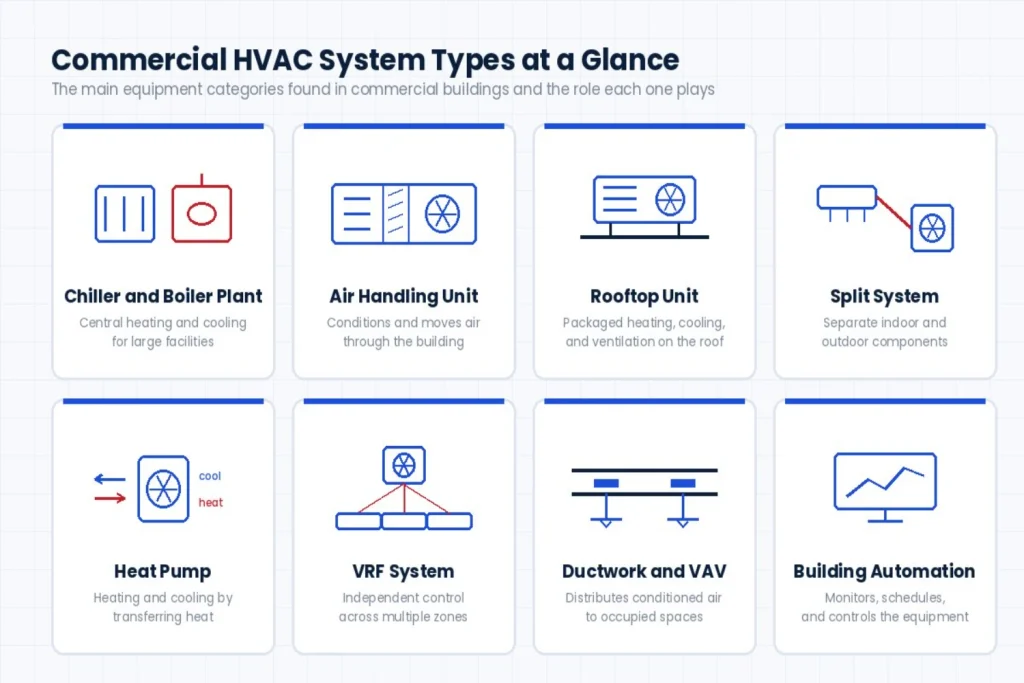
Commercial buildings rely on HVAC equipment to maintain comfortable temperatures, control airflow, protect indoor conditions, and support daily operations. Unlike residential systems, commercial HVAC setups can involve multiple pieces of equipment working together across large or complex spaces.
Understanding the main types of commercial HVAC systems can help facility managers recognize what equipment a building uses, understand how the components work together, and make better decisions about maintenance, repairs, and future upgrades.
In Midland, TX, commercial properties can range from offices and retail stores to warehouses, oilfield service facilities, fabrication shops, and other industrial buildings. Each property can have different heating and cooling requirements based on its size, layout, occupancy, equipment, and operating schedule.
Central Chiller and Boiler Systems
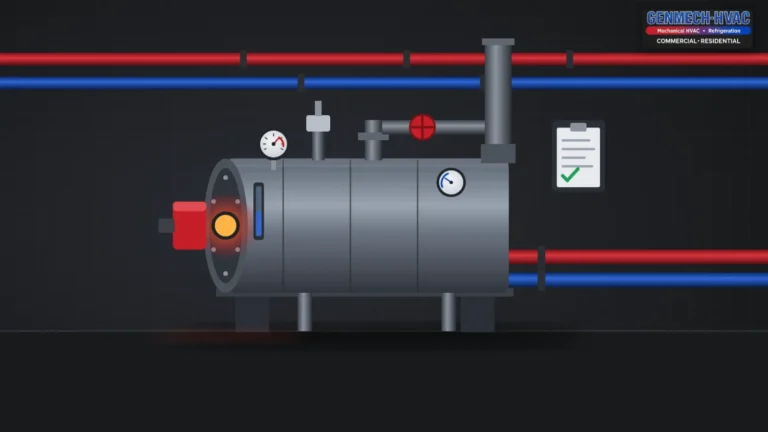
Chiller and boiler systems are commonly used in larger commercial facilities where centralized heating and cooling are practical.
A chiller removes heat from water and produces chilled water that can be circulated through the building. The chilled water travels to air handling units or other terminal equipment, where it helps cool the air before that air is distributed throughout the facility.
Boilers work in the opposite direction by producing hot water or steam for heating. Depending on the building design, the heated water can circulate through coils in air handling units or other heating equipment.
These systems require coordination between several components. Pumps, controls, valves, coils, sensors, and distribution equipment can all affect overall performance.
For facilities using this type of equipment, understanding the difference between heating and cooling production can make maintenance planning easier. GENMECH HVAC provides commercial chiller service and boiler service for central plant systems across West Texas.
Air Handling Units
An air handling unit, or AHU, is designed to condition and distribute air throughout a commercial building.
An AHU can contain components such as filters, heating and cooling coils, fans, dampers, and controls. Depending on the system, it may receive conditioned water from a chiller or boiler and use that energy to change the temperature of the air.
Air handling units are often connected to ductwork that distributes conditioned air to different areas of a building.
Because AHUs handle large volumes of air, problems with filters, coils, fans, dampers, or controls can affect airflow and comfort across multiple rooms or zones.
Facility managers should also consider the relationship between the air handler and the rest of the HVAC system. A properly operating air handler cannot compensate for restricted ductwork, failed controls, or inadequate cooling capacity elsewhere in the system.
Rooftop Units
Rooftop units, commonly called RTUs, are self-contained HVAC systems installed on the roof of a commercial building.
An RTU can provide heating, cooling, ventilation, and air distribution from a single piece of equipment. Ductwork then carries conditioned air throughout the building.
RTUs are frequently found on offices, retail properties, medical offices, and other commercial buildings because the equipment can be positioned outside the occupied space.
The rooftop location also means the equipment is exposed to outdoor conditions. Dust, heat, wind, moisture, and debris can affect filters, coils, electrical components, and other parts over time.
When an RTU develops a problem, the issue may involve airflow, refrigerant, electrical components, controls, motors, or other equipment. Commercial HVAC repair can involve diagnosing the underlying cause rather than simply replacing an individual component.
For new equipment or major replacement projects, commercial HVAC installation can help facilities select and install equipment according to the building’s requirements.
Split Systems
Commercial split systems separate major components between indoor and outdoor locations.
The outdoor section typically contains the compressor and condenser, while the indoor equipment handles air distribution and conditioning. Refrigerant lines connect the two sides of the system.
Split systems can be useful for individual areas, smaller commercial buildings, additions, or spaces that do not require a centralized system.
Ductless mini-split configurations are one version of this approach. For spaces without existing ductwork, ductless heating and cooling systems can serve individual rooms or additions without major construction.
Their configuration can vary considerably depending on the building and application. A facility manager should consider the size of the area being served, the required capacity, airflow requirements, equipment location, and controls when evaluating a split system.
Heat Pumps
Heat pumps transfer heat rather than simply creating heating or cooling through separate processes.
During cooling operation, a heat pump moves heat from inside the building to the outdoor environment. During heating operation, the refrigeration cycle can be reversed so heat is moved into the building.
This makes heat pumps useful for applications where both heating and cooling are needed from the same general equipment platform.
Their performance depends on proper sizing, airflow, refrigerant operation, controls, and the conditions in which the equipment operates. In commercial applications, these factors become particularly important when equipment serves larger occupied spaces.
VRF Systems
Variable refrigerant flow, or VRF, systems use refrigerant to serve multiple indoor units from a connected outdoor system.
One advantage of VRF equipment is the ability to provide different levels of heating or cooling to different zones. This can be useful in buildings where rooms have different occupancy patterns or temperature requirements.
For example, offices with different schedules may not require identical conditioning throughout the day. A zoned system can provide more control over how individual areas are conditioned.
VRF systems include outdoor units, indoor units, refrigerant piping, controls, and other components. Proper installation and commissioning are important because the system depends on coordination between these components.
Ductwork, VAV Boxes, and Diffusers
HVAC equipment can only perform effectively if conditioned air is distributed properly.
Ductwork carries air between the HVAC equipment and occupied spaces. VAV, or variable air volume, boxes regulate the amount of conditioned air delivered to individual zones. Diffusers then distribute air into the occupied area.
Problems in this portion of the system can affect comfort even when the primary HVAC equipment is operating.
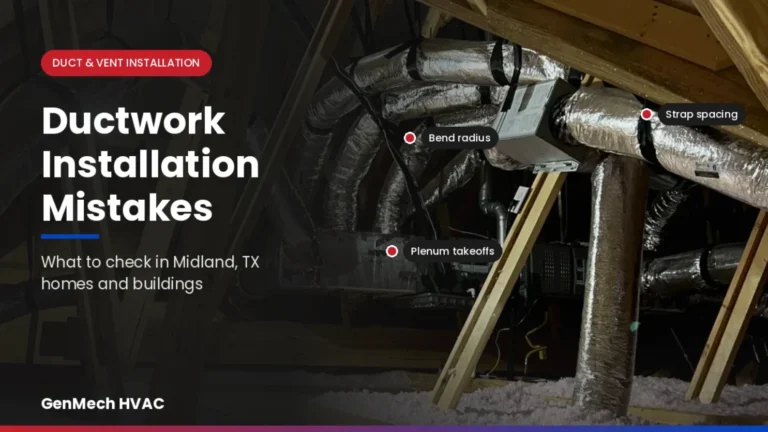
Restricted ducts, damaged insulation, air leakage, poor balancing, blocked registers, or malfunctioning dampers can change how much air reaches different parts of a building.
For facilities dealing with airflow issues, commercial duct and vent services can address components involved in air distribution, including ductwork, registers, exhaust systems, and airflow balancing.
Thermostats, Sensors, and Building Automation
Modern commercial HVAC systems often depend on controls to coordinate equipment operation.
Thermostats and sensors provide information about temperature and operating conditions. More advanced buildings may use a building automation system, or BAS, to monitor and control HVAC equipment across multiple areas.
A BAS can connect equipment such as RTUs, chillers, boilers, VAV systems, and other components. Facility personnel can use system information to identify operating conditions, review trends, and make adjustments.
Controls also help coordinate when equipment starts, stops, or changes capacity. If a sensor is inaccurate or a control sequence is not working correctly, the resulting problem may appear to be an equipment failure when the underlying issue is actually related to controls.
GENMECH HVAC provides building automation system services for commercial facilities that rely on HVAC controls and monitoring.
Choosing the Right System for a Commercial Building
There is no single HVAC configuration that fits every commercial property.
Facility managers typically need to consider several factors before selecting equipment:
- Building size and layout
- Number of occupants
- Operating hours
- Heating and cooling requirements
- Available equipment space
- Air distribution requirements
- Zoning needs
- Existing electrical infrastructure
- Maintenance requirements
- Future expansion plans
An office building may have different requirements from a warehouse. A retail property may need consistent cooling across customer areas, while an industrial facility may have equipment or processes that create additional heat loads.
The building’s existing infrastructure also matters. Replacing one component does not always mean the rest of the system is suitable for the new equipment.
Commercial HVAC Systems Across Midland Properties
Commercial HVAC requirements can vary significantly across Midland, TX.
An office building in the downtown area may rely on rooftop equipment, air handling units, or centralized systems serving multiple floors and tenant spaces. A retail property around Loop 250 may have multiple rooftop units serving different sections of the building.
Warehouses can present different challenges because of large open spaces, high ceilings, loading areas, and changing occupancy. Along corridors such as SH 191 and Wadley Avenue, commercial properties can also include combinations of retail, office, and service spaces.
Oilfield service facilities and fabrication shops require another level of consideration. These buildings may contain large work areas, equipment, storage zones, offices, and spaces with different ventilation or temperature requirements. HVAC planning needs to account for how the facility is actually used rather than relying only on building size.
Maintenance Is Part of the System
Commercial HVAC equipment is a system of connected components. Keeping the equipment operating requires more than responding after something stops working.
Routine maintenance can include inspecting equipment, checking filters, reviewing electrical components, examining coils, evaluating airflow, testing controls, and identifying developing problems.
The appropriate maintenance schedule depends on the equipment, building conditions, operating hours, and manufacturer’s requirements.
For facilities that want a structured approach to recurring service, commercial HVAC maintenance agreements can provide scheduled maintenance based on the needs of the property.
Maintenance can also help facility managers understand how equipment is performing over time. Changes in airflow, temperature control, equipment cycling, or operating behavior can provide useful information before a major failure occurs.
Common Signs of HVAC Problems
Commercial HVAC problems can show up through inconsistent temperatures, weak airflow, unusual equipment behavior, rising operating costs, or repeated service issues. For a detailed breakdown of warning signs and what facility managers should watch for, see our guide to commercial HVAC warning signs in West Texas.
A Technician’s Perspective
From a technician’s perspective, commercial HVAC problems rarely exist in isolation.
A cooling complaint may involve the equipment itself, but it can also be connected to airflow, ductwork, controls, sensors, refrigerant, electrical components, or another part of the system.
On rooftop units in Midland, our technicians regularly trace cooling complaints back to condenser coils loaded with dust after the spring wind season rather than to the compressor the customer expected to replace. In other cases, a building that appears to have a failing air handler turns out to have a control schedule that was never updated after a tenant changed its hours.
That is why proper diagnosis matters. Looking only at the component showing the symptom can result in treating the immediate problem without addressing the underlying cause.
For facility managers, keeping accurate equipment records and reporting changes in system performance can also help technicians diagnose problems more efficiently.
Planning for Long-Term HVAC Performance
Understanding the equipment in a commercial building gives facility managers a better foundation for maintenance, repairs, and future planning.
Chillers, boilers, RTUs, split systems, heat pumps, VRF equipment, air handling units, ductwork, and building controls all perform different roles. The right combination depends on the building, its occupants, its operating requirements, and its existing infrastructure.
For Midland, TX businesses, the local operating environment also makes equipment selection and maintenance an important part of facility planning. Heat, dust, building use, and equipment exposure can all influence how commercial HVAC systems operate over time.
GENMECH HVAC works with commercial and industrial facilities on HVAC repair, installation, controls, ductwork, commercial refrigeration, and ongoing maintenance. If you are evaluating an existing system or planning HVAC work for a commercial property, contact GENMECH HVAC to discuss the requirements of your facility.