Cold weather in West Texas does not arrive gradually. A Midland facility can sit at 70 degrees on Sunday afternoon and face a hard freeze warning by Tuesday morning. That swing is when most commercial boilers fail, because it is the first time all season the system is asked to run at full fire for hours at a stretch.
What follows is a representative case study. It is a composite built from the kinds of heating failures that happen in commercial buildings across Midland and the Permian Basin, not an account of a specific named customer. The details are common enough that any facility manager who has lost heat in January will recognize them.
The Morning the Heat Stopped
A mid-sized office and warehouse property opens at 7:00 a.m. The overnight low hit 22 degrees. By 7:20 the front office is 58 degrees and falling. The building runs a gas fired hot water boiler feeding hydronic loops on the office side and two unit heaters on the warehouse floor.
The maintenance lead walks down to the mechanical room and finds the boiler idle with a fault light showing. He cycles power. The unit fires, runs for about ninety seconds, then shuts down and locks out again.
He resets it four more times. Same result.
That reset loop is the single most common way a small repair turns into an expensive one. A safety lockout is not a nuisance. It is the control system reporting that a condition was measured and found unsafe. Repeatedly clearing it forces the equipment to keep attempting ignition under whatever fault caused the shutdown.
What Losing Heat Actually Costs a Business
By 9:00 a.m. the building is a problem, not an inconvenience.
The office side is cold enough that people are working in coats and productivity drops without anyone tracking it. Two scheduled client meetings get moved. In the warehouse, temperature sensitive inventory needs monitoring and the receiving crew slows down because they are handling product in gloves.
The real costs show up in places most facilities do not budget for:
- Staff time pulled away from normal work to babysit the mechanical room
- Emergency service premiums that scheduled maintenance would have avoided
- Product, fluid, or process losses in buildings where temperature affects the work
- Frozen or damaged piping if the outage runs into a second night
- Complaints from tenants, employees, or customers who cannot be told when heat returns
Older commercial properties around central Midland make this worse. Many were built with single zone heating and no meaningful backup, so one failed boiler takes the entire building down at once rather than one area.
For restaurants, medical offices, and food handling operations in Midland, the picture gets sharper. A building without hot water or reliable heat may not be able to open at all. A day of lost revenue almost always exceeds the cost of the repair that prevented it.
The Warning Signs Nobody Logged
Boilers rarely fail without notice. They fail after months of small signals that no one wrote down.
In this scenario, three things had been happening since October.
The unit had been short cycling. It fired, satisfied quickly, and shut off, then repeated. Staff assumed the mild fall weather explained it. Short cycling is usually a control, flow, or sizing problem, and every cycle puts thermal and electrical stress on components.
Gas usage had climbed. The bill went up in November without a corresponding change in occupancy or weather severity. Rising fuel consumption at the same load is one of the clearest indicators of degraded combustion or fouled heat transfer surfaces.
There had been two earlier lockouts. Both cleared on a reset, and nobody escalated it. A fault that clears on reset and comes back is the definition of an intermittent failure moving toward a permanent one.
None of this required special equipment to notice. It required someone to write it down and treat a pattern as information.
How a Technician Diagnoses a Commercial Boiler Failure
When a service call comes in on a locked-out boiler, guessing is expensive. A disciplined diagnostic sequence looks like this.
Read the fault before touching anything
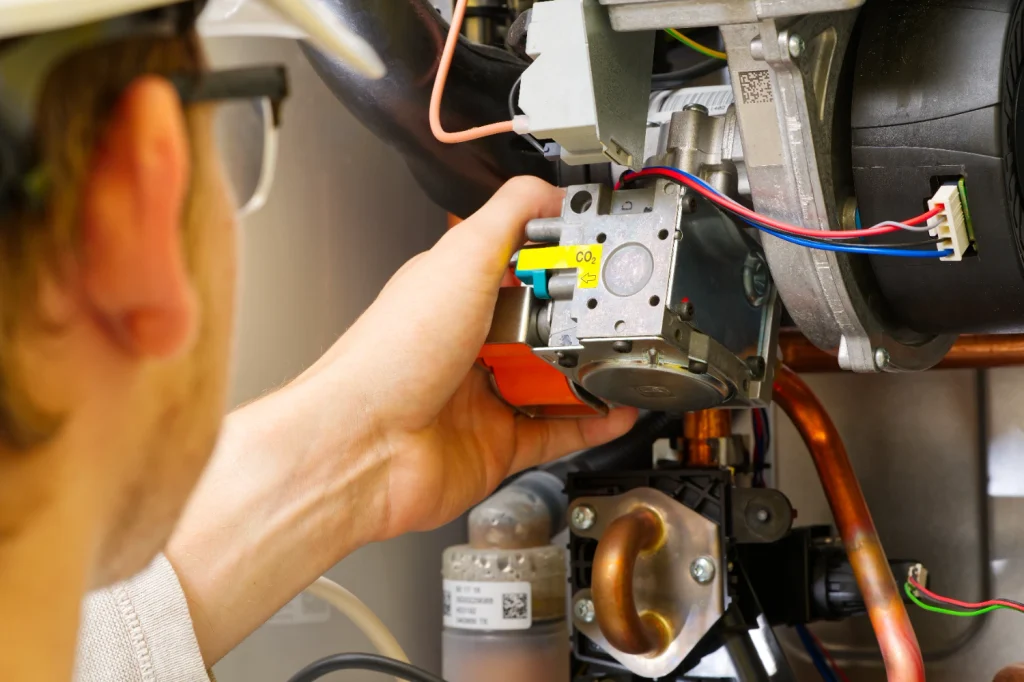
The first step is capturing the lockout code and the conditions present at shutdown, not clearing it. Flame failure, high limit, low water cutoff, and gas pressure faults each point at different systems. Clearing the code before reading it destroys the most useful evidence on the job
Verify the safety chain
Low water cutoff function, high limit setting, relief valve condition, and gas pressure at the valve get checked and documented. This step exists for a reason beyond diagnosis. A boiler operating with a bypassed or failed low water cutoff is a code violation and a genuine safety hazard, and no repair should be signed off until that circuit is proven functional.
Take combustion readings
A combustion analyzer measures oxygen, carbon monoxide, carbon dioxide, and stack temperature. These numbers tell the truth about how the burner is actually running. Stack temperature climbing well above the commissioning specification usually means scale or soot on the heat exchanger surfaces, which is a water treatment and cleaning issue rather than a burner issue.
Check the waterside.
Circulator performance, differential pressure, expansion tank charge, air in the loop, and system pressure stability all affect whether the boiler can transfer the heat it produces. Many failures that look like burner problems are hydronic problems in disguise.
Separate root cause from the symptom.
A dirty flame sensor is a symptom. The question is why it fouled. Poor combustion, an improper air-to-fuel ratio, or a drifting gas pressure setting will foul a replacement sensor within weeks. Replacing the part without correcting the condition guarantees a repeat call.
In this case the sequence pointed to a weak igniter combined with a gas pressure setting that had drifted low, which produced unstable ignition on a cold start and a flame failure lockout under heavy demand. The repair was straightforward. Finding it without the readings would not have been possible.
Why Delay Makes the Repair Larger
Every additional day a commercial boiler runs in a fault condition raises the cost of fixing it.
Incomplete combustion deposits soot on heat exchanger surfaces, and soot insulates. The system burns more gas to deliver less heat, and stack temperatures keep rising. Untreated water leaves scale on the water side, which does the same thing from the opposite direction. Both conditions accelerate heat exchanger damage, and a heat exchanger is not a minor line item.
Repeated hard lockouts also stress ignition components, gas valves, and control boards. What starts as a sensor or pressure adjustment can become a control board and valve replacement across one heating season.
Then there is the calendar. During a Permian Basin cold snap, every commercial heating contractor in the region is running emergency calls at once. A building that waited is competing for the same technicians as every other building that waited. Parts availability tightens at the same time, and a control board that ships overnight in October can take days to source in the middle of a regional freeze.
What Midland Facilities Should Do Differently
The businesses that make it through a West Texas winter without a heat emergency tend to do four unglamorous things.
They service the system before the season, not during it. Burner cleaning, safety testing, combustion tuning, and water chemistry checks in September cost a fraction of what the same work costs at 6:00 a.m. in January.
They keep a log. Fault codes, dates, reset counts, gas consumption, and anything that sounds or smells wrong. A written record turns three isolated annoyances into one diagnosable pattern. Photograph the fault code display before clearing it, every single time.
They never reset a lockout more than once. One reset to confirm the fault is reasonable. Two or more without a diagnosis is an unmanaged risk.
They know who they are calling before they need to. Having a commercial heating contractor who already knows the building, the equipment, and the access requirements removes hours from an emergency response.
FAQ
Why does my commercial boiler keep locking out? A lockout means a safety control measured an unsafe condition and stopped the burner. Common causes include flame failure from a dirty sensor or weak igniter, low water cutoff trips, high limit faults, and gas pressure problems. A lockout that clears on reset and returns is an intermittent fault heading toward a permanent one, and the fault code should be recorded before anything is cleared.
What causes a boiler to short cycle? Short cycling is usually a control problem, a flow problem, or an oversized boiler for the actual load. Common causes are a failing aquastat or sensor, poor circulation from a weak pump or air in the loop, an undercharged expansion tank, or improper differential settings. Each cycle adds thermal and electrical stress, so it shortens equipment life even while the building stays warm.
How do I know if my heating system needs repair or replacement? The decision comes down to heat exchanger condition, combustion efficiency against the original commissioning numbers, the cost of the current repair as a share of replacement cost, and remaining service life. A technician should give you readings that support the recommendation, not just an opinion.
Is it safe to keep resetting a boiler that shuts down? One reset to confirm the fault is reasonable. Beyond that, resetting forces the equipment to attempt ignition under whatever condition triggered the shutdown. With gas pressure faults or low water cutoff trips, repeated resets are genuinely unsafe and should not be attempted.
How often should a commercial boiler be cleaned? Most commercial gas fired boilers need burner cleaning and heat exchanger inspection annually, before the heating season. Buildings with hard water, high run hours, or dusty mechanical rooms often need it more frequently. Soot on the fire side and scale on the water side both reduce heat transfer and raise fuel cost.
What does a commercial heating maintenance visit include? A complete visit covers burner cleaning and inspection, combustion analysis with recorded readings, safety control testing including the low water cutoff and high limit, water chemistry checks, hydronic pressure and flow verification, and a written record of what was found. If you do not receive documented combustion numbers, the visit was not a full service.
Who Fixes a Commercial Boiler in Midland
Commercial and industrial boilers are not scaled up residential furnaces. They involve combustion analysis, pressure vessel safety, flame safeguard controls, and hydronic system behavior, which is a different body of knowledge from residential service work.
GENMECH HVAC works on gas-fired, steam, and hot water boilers for commercial and industrial facilities across Midland, Odessa, Lubbock, and San Angelo. The approach is the one described above: Read the data, find the root cause, verify performance under load, and give the building owner an honest repair or replace path.
If your system is short cycling, locking out, or burning more fuel than it did last winter, those are diagnosable conditions, and they are easier to correct before the next hard freeze. Learn more about our commercial boiler repair and service in Midland, TX or call (432) 528-8905 to schedule an evaluation.