If you manage a building anywhere in West Texas, you have probably heard the term “commercial HVAC” used to describe two very different things: the rooftop unit sitting above a strip center and the chilled water plant that conditions an entire multi-story facility. Both are commercial HVAC. The distance between them is where most facility managers get lost, and it is usually the moment a system fails that the difference starts to matter.
This guide explains what commercial HVAC means, how the major system types work, which buildings each one suits, and what a realistic maintenance program looks like for facilities in Midland, Odessa, and the wider Permian Basin.
What Is Commercial HVAC?
Commercial HVAC refers to the heating, ventilation, and air conditioning equipment that conditions nonresidential buildings: offices, retail centers, schools, warehouses, medical suites, convenience stores, and industrial facilities. When refrigeration equipment is part of the same scope, the field is usually written as HVACR.
The useful definition is not about building type. It is about three things that change once a building crosses out of residential territory.
- Load. Residential equipment is typically sized between 1.5 and 5 tons of cooling. Commercial equipment starts around 5 tons and scales into the hundreds of tons for chilled water plants.
- Code-driven ventilation. Commercial buildings must bring in a calculated volume of outside air based on occupancy and use. Residential systems mostly recirculate.
- System architecture. A house has one system. A commercial building often has a fleet of units, multiple zones, and a control layer coordinating all of it.
That last point is what trips up generalist contractors. Servicing a commercial building is rarely a matter of fixing one box. It is a matter of understanding how that box behaves inside a larger mechanical system.
Commercial HVAC vs Residential HVAC: What Actually Changes
Capacity and Equipment Design
Commercial equipment is built for continuous duty. Compressors, motors, and coils are specified for longer run times and heavier cycling than residential components, and a single facility may run a dozen units simultaneously. Sizing errors compound quickly across a fleet, which is why load calculations matter more here than in a single family home.
Ventilation and Indoor Air Quality Requirements
Occupied commercial space carries outside air requirements tied to how the building is used, so a classroom, a warehouse, and an open plan office each have different ventilation profiles. Economizers, outside air dampers, and exhaust systems exist to satisfy those requirements, and every one of them can fail without anyone noticing until air quality complaints start.
Zoning and Control Complexity
Residential zoning is usually a damper and a second thermostat. Commercial zoning can involve variable air volume boxes, reheat coils, multiple thermostats reporting to a central controller, and scheduling logic tied to occupancy. When one suite is freezing and the suite next door is warm, the cause is frequently in the controls rather than the equipment.
Placement, Access, and the Cost of Downtime
Most commercial equipment lives on a roof or in a dedicated mechanical room, so replacing a failed rooftop unit can require a crane lift, roof curb adaptation, and coordination with building occupants. That is ordinary work for a commercial contractor and an obstacle for a residential company without the equipment to plan the lift.
The stakes differ too. When a home system fails, the household is uncomfortable. When a commercial system fails, a business may lose productivity, tenants, inventory, or the ability to stay open, which is why commercial buildings run scheduled maintenance instead of waiting for a breakdown.
How a Commercial HVAC System Works
Nearly every commercial system is built from the same functional layers, and knowing them makes troubleshooting conversations far easier to follow.
The Air Side
Everything that moves and treats air: supply and return fans, air handlers, ductwork, filters, dampers, diffusers, and terminal boxes. Air side problems show up as uneven temperatures, weak airflow, pressure complaints at doors, or dust accumulation.
The Water Side
Larger buildings move thermal energy using water rather than air. Chillers produce chilled water, boilers produce hot water or steam, pumps circulate it, and cooling towers reject heat. Water side problems show up as capacity loss, poor delta T across coils, or short cycling.
The Refrigeration Circuit and the Control Layer
Compressor, condenser, metering device, evaporator. Every piece of cooling equipment on the property runs this cycle, and refrigerant charge, superheat, and subcooling are the diagnostic fundamentals a technician checks before replacing parts. Sitting above all of it, sensors, controllers, and scheduling logic decide when equipment runs and how hard. A building can have mechanically sound equipment and still perform badly because the controls are fighting each other.
Types of Commercial HVAC Systems
These are the types of commercial HVAC systems you are most likely to encounter across West Texas facilities.
Packaged Rooftop Units (RTUs)
The most common commercial configuration in the region. All components sit in one cabinet on the roof, connected through a curb and duct drops. RTUs are straightforward to service, easy to replace one at a time, and well suited to single-story retail, offices, and light industrial space. The tradeoff is that roof-mounted equipment takes the full brunt of West Texas sun, wind, and airborne dust. RTU service and replacement are core parts of commercial HVAC services for most single-story buildings.
Split Systems and Multi-Split Systems
The condensing unit sits outside and the evaporator inside, connected by refrigerant lines. Common in smaller offices, suites within a larger building, and server rooms needing dedicated cooling independent of the main system.
Chilled Water Systems
A chiller cools water, pumps distribute it to air handlers or fan coils throughout the facility, and a cooling tower rejects heat. Chilled water is the standard approach for large facilities where running refrigerant lines everywhere would be impractical. These systems are efficient at scale and demanding to maintain, since water treatment, pump performance, and tower condition all affect capacity. Facilities running this equipment generally need a contractor who handles chiller repair directly rather than subcontracting it.
Boilers and Hydronic Heating
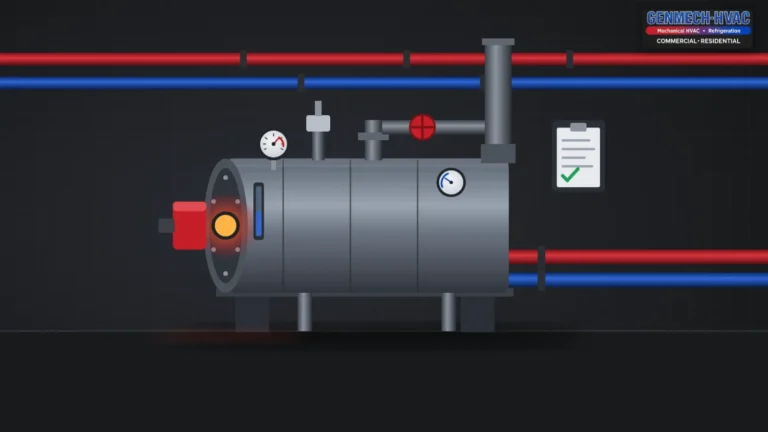
Boilers generate hot water or steam for heating coils, reheat loops, and process needs. Commercial boiler work sits under different training and safety requirements than air side service, which is one reason many local HVAC companies decline it. Combustion tuning, safety controls, and water quality all need periodic attention. Boiler repair for commercial buildings is specialist work and should be treated that way.
Variable Air Volume (VAV) Systems
A central air handler supplies air at a constant temperature, and VAV boxes at each zone modulate airflow, often with a reheat coil, to hit local setpoints. VAV is common in multi tenant office buildings. When one suite is never comfortable, a stuck VAV damper or a failed zone sensor is a frequent culprit.
Variable Refrigerant Flow (VRF) Systems
VRF uses a single outdoor unit serving multiple indoor units, varying refrigerant flow to match each zone. Some configurations can heat one zone while cooling another. VRF suits buildings with widely varying zone loads and limited space for ductwork, and it depends heavily on correct commissioning and controls setup.
Ductless Systems
Useful for additions, converted space, and areas the central system was never designed to reach. Ductless equipment avoids duct losses and installs with minimal disruption, which makes it a practical fix for problem zones. Ductless heating installations are common where extending existing duct runs is not feasible.
Commercial Refrigeration
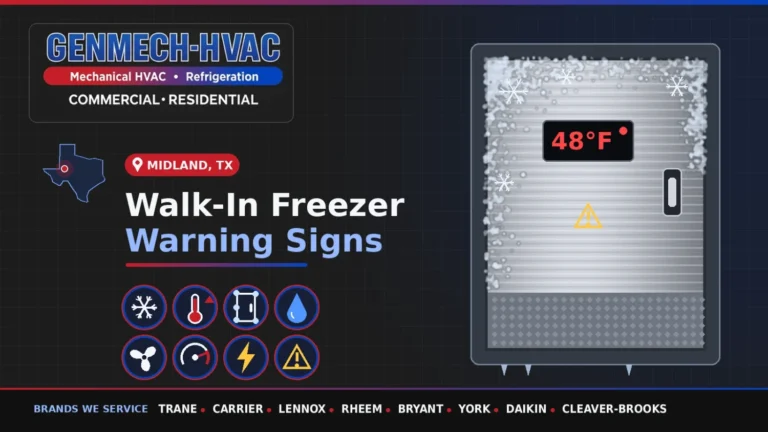
Walk-in coolers, freezers, display cases, and convenience store systems are related but distinct disciplines. The refrigeration cycle is the same, but the equipment, controls, and consequences of failure are different, since product loss begins within hours. Buildings that need both comfort cooling and product refrigeration benefit from a contractor covering both under one commercial refrigeration scope.
Building Automation Systems: The Layer That Ties It Together
A building automation system, usually shortened to BAS, is the software and controls network that monitors and directs mechanical equipment across a facility. It handles scheduling, setpoints, alarms, sensor trending, and remote access.
BAS matters for three practical reasons. It lets a facility manager see a fault before an occupant reports it. It removes guesswork from diagnostics by showing what the equipment was doing before it failed. And it prevents equipment running full output in an empty building overnight.
The catch is that a BAS is only as good as its commissioning and upkeep. Drifted sensors, overridden points left in place after a service call, and outdated schedules quietly undo the benefit, so reviewing control logic belongs in the maintenance scope. Facilities running networked controls should confirm their contractor supports building automation systems rather than treating controls as a separate trade.
What Commercial HVAC Maintenance Actually Involves
A real maintenance program is not a filter change with an invoice attached. It is a scheduled inspection cycle built around how the equipment fails.
What a Program Typically Covers
- Filter replacement on a schedule matched to the building environment, not a generic calendar.
- Coil cleaning on both condenser and evaporator sides, since fouled coils raise head pressure and cut capacity.
- Belt, bearing, and motor amperage checks, plus refrigerant charge verification through superheat and subcooling rather than gauge pressure alone.
- Electrical inspection of contactors, capacitors, terminal torque, and control wiring.
- Condensate drain clearing and pan inspection, a common source of ceiling damage.
- Economizer and damper operation, which fail silently more often than any other component.
- Water treatment, pump performance, and tower inspection on chilled water systems.
- Combustion and safety control checks on boilers and gas heat sections.
- Control logic and schedule review where a BAS is present.
Why West Texas Conditions Change the Schedule
Regional conditions shorten maintenance intervals in ways generic manufacturer guidance does not account for. Caliche dust and airborne particulate load condense coils faster than in most markets. Extended cooling seasons with sustained high ambient temperatures push compressors into elevated head pressure for months at a time. Wind-driven debris packs into roof-mounted equipment, and facilities near oilfield activity see additional particulate exposure.
The practical result is that a rooftop unit in Midland often needs coil cleaning more frequently than the same unit in a milder climate. Building the schedule around local conditions rather than a default interval is one of the more meaningful things a facility manager can do for equipment life, and a structured maintenance agreement is how most buildings formalize it.
Warning Signs a Commercial System Needs Attention
- Rising energy consumption with no change in occupancy or weather.
- Zones that never hold a setpoint, particularly at the ends of duct runs.
- Short cycling, meaning equipment starting and stopping in rapid succession.
- Ice on refrigerant lines or the evaporator coil.
- Water staining on ceiling tiles below air handlers.
- New noise: grinding, squealing, or a hard clunk on startup.
- Repeat nuisance alarms on the BAS that get cleared without a root cause fix.
Each of these has a diagnostic path behind it. Treated early, most are minor. Ignored through a West Texas summer, several become compressor replacements.
Which Facilities Rely on Commercial HVAC in the Midland and Odessa Area
The building mix across the Permian Basin produces a specific set of mechanical needs.
- Office buildings and multi-tenant suites, where zoning and comfort complaints usually resolve on the control side.
- Retail centers and storefronts, typically RTU fleets where staggered equipment ages create uneven reliability.
- Convenience stores, combining comfort cooling and product refrigeration, where refrigeration failures carry higher urgency.
- Schools, with heavy ventilation requirements, seasonal occupancy swings, and tight service windows.
- Medical and professional suites, where consistent temperature and humidity control matter more than raw capacity.
- Warehouses and distribution space, where high-volume ventilation matters more than conventional comfort cooling.
- Industrial and oilfield service facilities, where dust and continuous operation compress maintenance intervals.
Facilities across Midland, Odessa, Lubbock, and San Angelo often run mixed equipment inherited from several previous contractors. Consolidating that under one commercial HVAC contractor is usually the first step toward predictable service.
How to Evaluate a Commercial HVAC Partner
Residential experience does not transfer cleanly to commercial work. When evaluating a contractor, the questions worth asking are specific.
- Does the license cover the scope? Texas HVAC contractors hold TDLR licensing. GENMECH HVAC operates under TACLA028795C.
- Do they self-perform chiller and boiler work or subcontract it? Subcontracted specialty work adds a layer between you and the diagnosis.
- Can they work inside your building automation system, or only on the equipment?
- Which manufacturers are they trained on? Equipment-specific training affects diagnostic speed and parts sourcing.
- What documentation comes back after a service visit? Readings, findings, and photos should be standard.
GENMECH HVAC is a veteran-owned, family-operated HVACR contractor serving West Texas, with decades of combined technician experience across chillers, boilers, building automation, rooftop equipment, and commercial refrigeration. Our technicians are trained and certified across Trane, Carrier, York, Daikin, Lennox, Rheem, Bryant, and Cleaver-Brooks systems.
Frequently Asked Questions
How is commercial HVAC different from residential HVAC?
Commercial systems carry larger loads, must satisfy code-driven outside air ventilation requirements, use multi-zone control strategies, and are usually installed on roofs or in mechanical rooms. Equipment, diagnostics, and service logistics all differ from residential work.
How often should a commercial HVAC system be serviced?
Most commercial buildings run quarterly service, with additional visits before the cooling and heating seasons. In dusty West Texas conditions, condenser coil cleaning often needs to happen more frequently than a standard interval would suggest.
How long does commercial HVAC equipment last?
Rooftop units commonly run 15 to 20 years, chillers can exceed 20 to 25 years with proper water treatment, and boilers vary widely by type and maintenance history. Maintenance quality has more influence on lifespan than the manufacturer.
Can one contractor handle both HVAC and refrigeration?
Yes, though many do not. The two share refrigeration cycle fundamentals but differ in equipment and controls. Buildings needing both, such as convenience stores, benefit from one contractor covering the full scope.
Final Thoughts
Commercial HVAC is best understood as a system rather than a piece of equipment. The rooftop unit, the chiller, the boiler, the ductwork, and the control layer all influence each other, and problems that look mechanical often turn out to be control problems or maintenance left alone too long.
For facility managers in Midland, Odessa, and across the Permian Basin, the highest value decision is usually not which unit to buy. It is committing to a maintenance schedule built around actual operating conditions, with a contractor who understands the whole system.
To review your building equipment or discuss a maintenance schedule for your facility, explore our commercial HVAC services or contact GENMECH HVAC at (432) 528-8905.