Ask most Midland business owners what cools their building, and the answer is usually a shrug toward the roof. That is fair. The equipment is out of sight, it runs until it does not, and the names get thrown around loosely. Chiller, air handler, rooftop unit. They are not interchangeable, and knowing which one you have changes how you maintain it, how you budget for replacement, and who you call when it fails in July.
This guide breaks down the differences between chillers, air handling units, and rooftop units: how to recognize each one, how each one works, where it is located, and which setup is most common in commercial buildings across Midland, TX, and the Permian Basin.
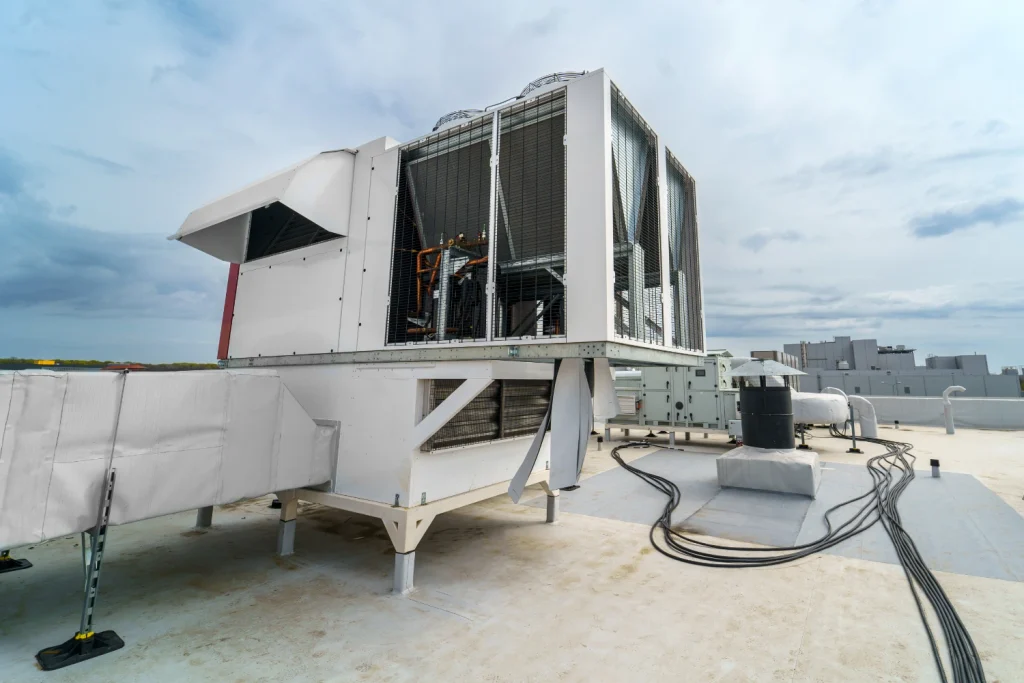
Chillers: The Central Plant Approach
A chiller does one job. It produces chilled water, typically in the low to mid 40s Fahrenheit, and pumps it around the building. That water flows through coils inside air handlers and fan coil units, where warm building air passes over the coils and gives up its heat. The now warmer water returns to the chiller, the chiller pulls the heat out through a refrigerant loop, and the cycle repeats.
What separates the two chiller types is how the chiller gets rid of that heat.
Water-Cooled Chillers
A water-cooled chiller usually lives in a basement or ground-floor mechanical room. It cannot reject heat on its own, so it pairs with a cooling tower on the roof. Condenser water carries heat from the chiller up to the tower, where fans pull outside air across the water and evaporation releases the heat to the atmosphere.
You can spot a water-cooled system from the parking lot: if there is a cooling tower on the roof, there is a water-cooled chiller somewhere below it. These systems are common on large campuses with heavy, steady cooling loads, and it is normal to see two or three chillers and towers installed for redundancy. In Midland you will find them at hospitals, larger office towers, and institutional buildings.
Air-Cooled Chillers
An air cooled chiller does the same job but sits outside, on the roof, or in a fenced yard and uses large fans to blow ambient air across its condenser coils. No cooling tower, no condenser water loop, no water treatment program.
Air cooled chillers fit medium to large commercial properties that need chilled water but do not want the water consumption, chemical treatment, and added equipment that come with a tower. In a region where the city has kept Stage 1 water restrictions in place for years as a standing conservation measure, that trade-off matters to a lot of Midland facility managers.
Air Handling Units: Moving and Conditioning the Air
An air handling unit, or AHU, is the box that actually moves air through a building. It contains fans, filters, dampers, and heating and cooling coils. The AHU pulls in a mix of return air from the building and fresh outdoor air, filters it, passes it across the coils to heat or cool it, and pushes it through supply ductwork to the occupied spaces. A second set of ducts brings used air back to the unit to be exhausted or recirculated.
The key point is that an AHU does not usually make its own cooling. The coils are fed by a central plant, which in most cases means a chiller. An AHU is one half of a system. The chiller is the other half.
AHUs traditionally sit inside the building in a mechanical room or rooftop penthouse, though weathertight outdoor AHUs are increasingly placed on the roof to free up interior space. Older buildings often ran one large AHU for the whole structure. Newer buildings tend to use several smaller AHUs serving different zones, which improves comfort and cuts energy use because you are not conditioning empty areas.
Rooftop Units: The Self-Contained Option
A rooftop unit, or RTU, looks a lot like an outdoor AHU, which is where the confusion starts. The difference is what is inside. An RTU is a packaged system. It carries its own compressor, condenser, evaporator coil, fans, filters, dampers, and controls in one weatherized cabinet. It also usually carries its own heat source, either a gas fired section or an electric heat pump.
In other words, an RTU does not need a chiller. It makes its own cooling on the roof and sends conditioned air down through ductwork to the space below. That self contained design is why RTUs dominate retail strips, restaurants, medical offices, schools, and single story office buildings. They are compact, relatively simple, and a building can add units as zones are added.
Because everything sits in one box on the roof, a technician can service the whole system without walking through the tenant space.
How to Tell Which One You Have
A quick field guide:
If there is a cooling tower on the roof and a large machine in a ground floor mechanical room, you have a water-cooled chiller feeding AHUs.
If there is a large fan bank unit outside with no tower, plus insulated water piping running into the building, you have an air cooled chiller feeding AHUs.
If there are several similar metal cabinets on the roof, each with its own condenser fans and each connected directly to ductwork, you have rooftop units.
If there is a big cabinet with ductwork but no condenser fans of its own, it is an AHU, and something else is doing the cooling.
What Is Most Common in Midland, TX?
Rooftop units, by a wide margin. The commercial building stock in Midland and Odessa is dominated by single-story and low-rise construction with flat roofs: retail centers along Loop 250, office parks, medical suites, oilfield service company shops, restaurants, and schools. That building type and packaged RTUs were made for each other.
Midland’s climate reinforces the pattern. The area sees well over a hundred days a year above 90 degrees and a long cooling season running from May into late September, with average humidity near 32 percent. RTUs handle that kind of sustained dry heat well, and the flat roofs give them the airflow they need.
Chilled water systems show up in a narrower set of buildings: hospitals, the larger downtown office towers, and institutional campuses where the cooling load is large and constant. Within that group, the dry West Texas air actually favors cooling towers, because evaporation works very well when humidity is low. The catch is water. Most of Midland’s supply is piped in from lakes well over a hundred miles away, and the city has treated water conservation as a permanent posture rather than an emergency measure. That pushes many mid sized facilities toward air cooled chillers or larger RTUs instead of a tower.
One more local factor: dust. Blowing dust and caliche grit load filters and coat condenser coils faster here than in most markets, whether the equipment is an RTU on a roof or an air cooled chiller in a yard. Maintenance schedules borrowed from Houston or Dallas are often too relaxed for the Permian Basin.
Why the Difference Matters to a Building Owner
Maintenance is different. An RTU is one self contained machine with a refrigerant circuit, so service focuses on the compressor, coils, belts, filters, and controls. A chiller plant is a system of systems: the chiller itself, pumps, piping, water treatment, cooling tower, and every AHU downstream. A problem in one part can show up as a comfort complaint somewhere else entirely.
Failure looks different. When one RTU goes down, one zone gets hot. When a chiller goes down, every AHU it feeds loses cooling at once. That is why chiller plants are usually built with redundancy and why preventive service on them is not optional.
Replacement is different. RTUs are swapped unit by unit on a rolling schedule. Chillers and AHUs are capital projects that need rigging, engineering, and downtime planning.
The contractor is different. Plenty of companies can service a rooftop unit. Far fewer can diagnose a chiller, balance a hydronic loop, or troubleshoot the controls that tie a chiller plant together. If your building runs on chilled water, that matters more than anything else on the vendor checklist.
Frequently Asked Questions
Is a rooftop unit the same as an air handler?
No. They look similar and both move air through ductwork, but an RTU contains its own refrigeration system and makes its own cooling. An AHU depends on a separate source, usually a chiller, for its cooling and heating.
Can a building have both an RTU and a chiller?
Yes. It is common for a large facility to run a chiller plant for the main building and add packaged RTUs for later additions, server rooms, or outbuildings where extending chilled water piping was not practical.
Which lasts longer in West Texas, an RTU or a chiller?
With consistent maintenance, packaged RTUs in the Midland climate commonly reach 15 to 20 years, and chillers often run longer. The dust and heat here shorten those numbers quickly when filter and coil service is skipped.
Conclusion
Chillers produce cold water, AHUs move and condition air using that water, and RTUs do the whole job in one cabinet on the roof. Most Midland commercial buildings run on rooftop units because the building stock and the climate favor them, while chilled water plants serve the larger hospitals, towers, and campuses that need central cooling.
GENMECH HVAC services Chiller repair and maintenance in Midland, TX, with technicians whose combined experience of more than 30 years covers chillers, cooling towers, air handlers, rooftop units, and the building automation systems that tie them together. If you are not certain what is on your roof or in your mechanical room, our commercial HVAC team can walk the building with you and tell you exactly what you have and how it is performing