It usually starts the same way. It is a Tuesday in late July, the thermometer is reading 104, and somebody walks into a back office to say the sales floor is getting warm. By the time anyone climbs a ladder to look at the roof, the unit has already been struggling for weeks.
Ask a facility manager in the Permian Basin when their HVAC problems show up, and you will hear the same two months. July and August. Not because equipment picks a season to quit, but because those are the months when West Texas heat finally finds every weakness that was already there.
This article breaks down why commercial rooftop HVAC units fail during peak summer in Midland, what those failures actually cost a business, and what drives the number when a contractor quotes a replacement.
Why July and August Break Equipment That Was Fine in May
The equipment is running at the edge of its design limits
Most commercial rooftop units are rated to reject heat at a specific outdoor ambient temperature. When Midland sits at 100 to 108 for days at a time, and the roof surface under that unit is running considerably hotter than the air temperature, the condenser has a much harder time pulling heat out of the refrigerant. Head pressure climbs. The compressor works harder for less cooling. A unit that held a setpoint comfortably in May is now running almost continuously and never getting a rest cycle.
That continuous run time is the real culprit. A marginal capacitor, a pitted contactor, or a slightly low refrigerant charge will hide all spring. Give it three weeks of near-constant operation in August, and it stops hiding.
Caliche dust and cottonwood clog condenser coils
This part is specific to West Texas. Between caliche dust off unpaved lots and lease roads, blowing sand, and cottonwood in early summer, condenser coils in Midland foul faster than they do in most of the country. A coil packed with dust behaves like a blanket over the unit. Airflow drops, heat rejection drops, and the compressor overheats.
We pull panels on commercial rooftop air conditioning units every summer where the coil is so loaded you cannot see light through it. The customer did nothing wrong. Nobody had been on the roof in two years.
Spring hail damage shows up as a July failure
Midland and Odessa take hail nearly every spring. Flattened condenser fins do not usually shut a unit down in April, because the load is light and the system can still limp along. Those bent fins become a failure in August when the unit needs every bit of its capacity. A lot of what gets diagnosed as a summer breakdown actually started as storm damage months earlier, which matters if there is an insurance claim on the table.
Undersized and aging equipment finally runs out of room
Buildings change. A retail space that was open floor becomes three offices with a server closet. A convenience store adds a second bank of coolers, and every one of those cases dumps heat into the same conditioned space. The rooftop unit was correctly sized for the old load and is now short by a meaningful margin. It will hold in mild weather and give out in August.
Aging commercial rooftop HVAC units make this worse. Once a unit passes the twelve to fifteen year mark in this climate, real capacity has usually drifted below where it started, even when the nameplate says otherwise.
The Failure Points We See Most Often in Peak Summer
Across the commercial HVAC rooftop units we service in Midland each summer, the same short list comes up over and over:
- Failed run capacitors, which is the single most common summer no-cool call
- Burned or welded contactors from constant cycling
- Compressor overheating and thermal lockout
- Refrigerant loss at brazed joints and service valves, made worse by vibration and roof heat
- Seized condenser fan motors, which can take the compressor down with them within hours
- Economizer dampers stuck open, pulling 100 degree outside air into the return
- Blocked condensate drains backing water into the unit or the ceiling below
Most of these are inexpensive parts. What makes them expensive is when they fail on a Friday afternoon in August, with no maintenance history and no parts on the shelf.
What a Failed Rooftop Unit Actually Costs a Midland Business
Owners think about the repair invoice. The repair invoice is usually the smallest number in the equation.
Convenience stores and fuel stops: When the rooftop unit goes down, the ambient temperature in the store climbs, and every reach-in cooler and walk-in starts fighting a losing battle. Refrigeration equipment sized for a 75-degree store is suddenly working in an 88-degree store. You risk product loss on top of comfort loss, and your refrigeration system absorbs the abuse.
Retail and showrooms: Customers do not complain. They leave. There is no line item for that, but anybody who has run a store through an August outage knows what a hot Saturday does to the day’s numbers.
Offices and multi-tenant properties. Property managers here are dealing with lease obligations, not just comfort. Tenants have expectations written into their agreements, and a multi-day outage during peak season turns into a renewal conversation nobody wanted.
Medical, dental, and lab spaces | Supplies and equipment often carry storage temperature requirements. An outage becomes a compliance problem fast.
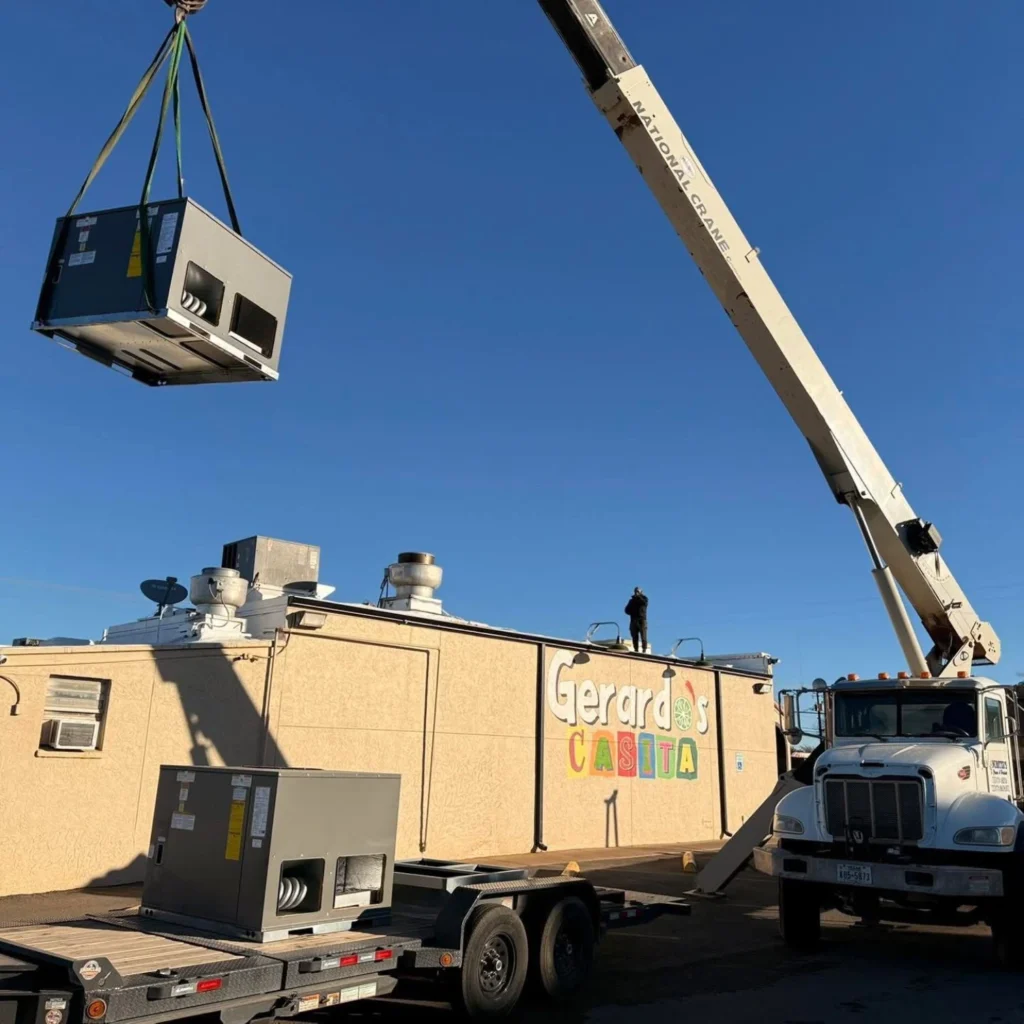
Then there is the part nobody plans for. In July and August, every HVAC contractor in the Permian Basin is running at capacity and parts distributors run thin on common components. If the unit needs replacement rather than repair, you are looking at equipment lead time plus crane scheduling, and you do not get to pick the week.
What Drives Commercial Rooftop HVAC Units Cost in Midland
This is the question we get most, and it is a fair one. We do not publish figures, because an honest number depends on your building, but here is a straight look at what moves it.
Tonnage and configuration. Capacity is the starting point. Beyond that, gas heat versus electric heat, single zone versus multi-zone, and standard versus high efficiency all change the equipment itself.
Curb fit: If the new unit does not match the existing roof curb footprint, a curb adapter has to be fabricated. This is one of the most common surprises on a replacement quote.
Crane and roof access: A changeout in a tight downtown lot with power lines overhead is a different job than one on an open commercial lot off Loop 250. Crane size, setup location, and traffic control all factor in.
Electrical and controls: Existing disconnect and wire sizing may not carry the new unit. If the building runs a building automation system, the new equipment has to talk to it correctly, which is engineering time, not just installation labor.
Everything around the opening. | Permits, roof penetration repair, economizer requirements, and refrigerant line work.
This is why searching for 5-ton commercial rooftop HVAC unit prices rarely produces a useful answer. The cost of the box is one component. What varies between two buildings on the same street is everything around it. Broad ranges published online for commercial rooftop HVAC unit prices almost never account for curb adapters, crane time, electrical upgrades, or permitting in a West Texas market.
The way to get a real number is an onsite assessment where somebody measures the curb, checks the electrical, and looks at what is actually up there.
What to Look For When Choosing a Replacement Unit
Facility managers often ask which are the best commercial rooftop HVAC units for this region. Rather than name a model, here is what actually matters in the Permian Basin:
- High ambient performance: Confirm the unit is rated to run reliably at the temperatures we actually see, not only at standard rating conditions.
- Coil protection: Coated coils deserve serious consideration here, given caliche dust and airborne chemicals near industrial sites.
- Serviceability: Hinged access panels and reachable components save labor on every future call.
- Local parts availability: A unit is only as good as how quickly you can get a board or a motor for it in Midland.
- Controls compatibility: If you have a building automation system or plan to add one, verify compatibility before purchase, not after.
GenMech HVAC is trained and certified on Trane, Carrier, York, Daikin, Lennox, Rheem, and Bryant equipment, so the recommendation comes from what fits the building rather than what is easiest to source.
How to Keep July From Becoming an Emergency
Almost everything above is preventable, and the prevention window is February through April.
- Get on the roof in spring for coil cleaning, belt and motor inspection, electrical connection tightening, charge verification, and drain clearing before the load arrives.
- Document hail damage when it happens: Photograph coils after spring storms so there is a record if a claim comes later.
- Track your equipment: model, serial number, install date, and repair history for every unit. This is what turns a panic replacement into a planned capital expense.
- Reassess load after any build-out Added walls, added coolers, and added occupancy change what the unit has to do.
- Put critical buildings under agreement: Scheduled service means the unit gets attention before the season, and it means you are not starting from zero if something does break in August.
Frequently Asked Questions
How long should a rooftop unit last in West Texas?
Fifteen to twenty years is a common range nationally. In Midland, with the heat load and the dust, planning around the lower end of that range is more realistic. Maintenance history moves the number more than brand does.
Is it better to repair or replace an aging unit?
Age, repair history, refrigerant type, and current capacity against actual building load all factor in. If a unit is past fifteen years, uses a phased out refrigerant, and has had multiple compressor-related repairs, replacement usually makes more financial sense than one more fix.
Why does my unit only struggle in the afternoon?
That is a capacity and heat rejection signal. The system holds through the morning and loses ground as ambient and roof surface temperatures peak. It typically points to a fouled coil, a low charge, or a unit undersized for the current load.
Can a rooftop unit be replaced without shutting the business down?
Frequently yes, with planning. Early morning crane work and staged changeouts keep most retail and office operations running through the swap.
The Bottom Line
July and August do not create rooftop unit failures in Midland. They expose the ones that were already forming. The businesses that get through a Permian Basin summer without an outage are almost always the ones that put eyes on their equipment in the spring.
GenMech HVAC is a veteran-owned, family-operated commercial HVAC and refrigeration contractor based in Midland, serving Midland, Odessa, Lubbock, and San Angelo. If you have a unit that struggled last summer, or you want an honest assessment of what your building needs before the next one, call (432) 528-8905, and we will get somebody on your roof. Get a quote.