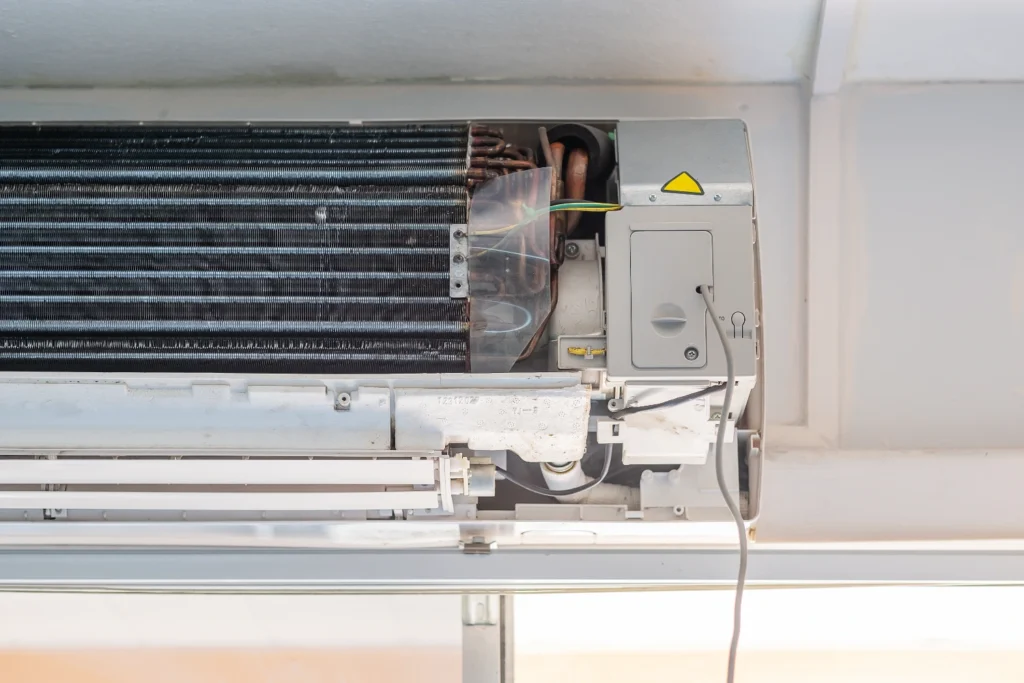
A residential HVAC system is built to keep one household comfortable inside a single conditioned space. A commercial HVAC system is built to move large volumes of conditioned air and required outside air through multiple zones used by different people at different hours. The difference between commercial and residential HVAC is not just size. It changes how the equipment is engineered, where it sits, who is licensed to service it, and what happens to your business when it fails on a July afternoon.
That matters more in Midland than in most of Texas. Summer design conditions across the Permian Basin sit near 100 degrees dry bulb, so equipment runs long hours against a high outdoor temperature while pulling in dusty air.
The Difference Most Comparisons Miss: Outside Air
A residential system is a recirculation machine. It conditions indoor air and pushes it back out, with fresh air arriving through the building envelope. A commercial system is different by code. Buildings occupied by the public carry ventilation requirements under ASHRAE Standard 62.1, so the system must introduce a calculated volume of outdoor air based on occupancy.
That matters here because at 100 degrees outside, every cubic foot per minute of required ventilation air has to be cooled down to supply temperature. A home never carries that load, which is why commercial equipment here is sized with more capacity per square foot than a house of the same footprint.
Field note: the stuck economizer
The most common energy problem we find on commercial rooftop units in Midland is not a failed compressor. It is an economizer damper stuck partly open, pulling 100-degree air into the building all day while the compressor runs trying to catch up. Owners assume the unit is undersized. It is usually a fifteen-minute controls diagnosis, and residential equipment has no economizer at all.
Equipment: Split System vs Packaged Unit
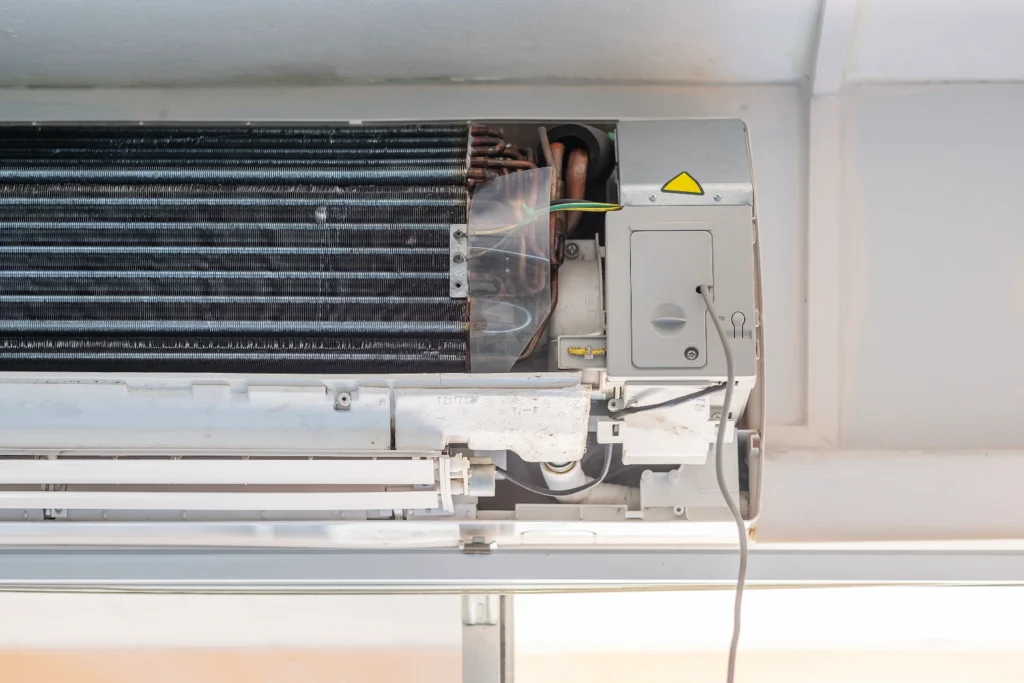
The standard residential HVAC system in Midland is a split system: a condenser outside on a pad, coil and air handler in an attic or closet, two to five tons, single-phase power, and one thermostat for the house.
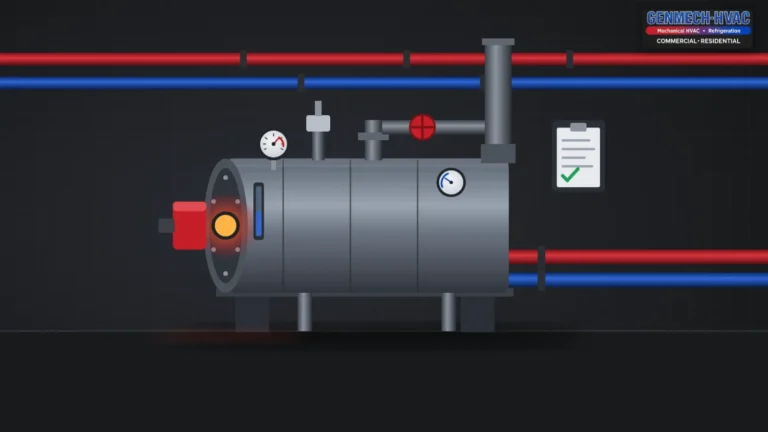
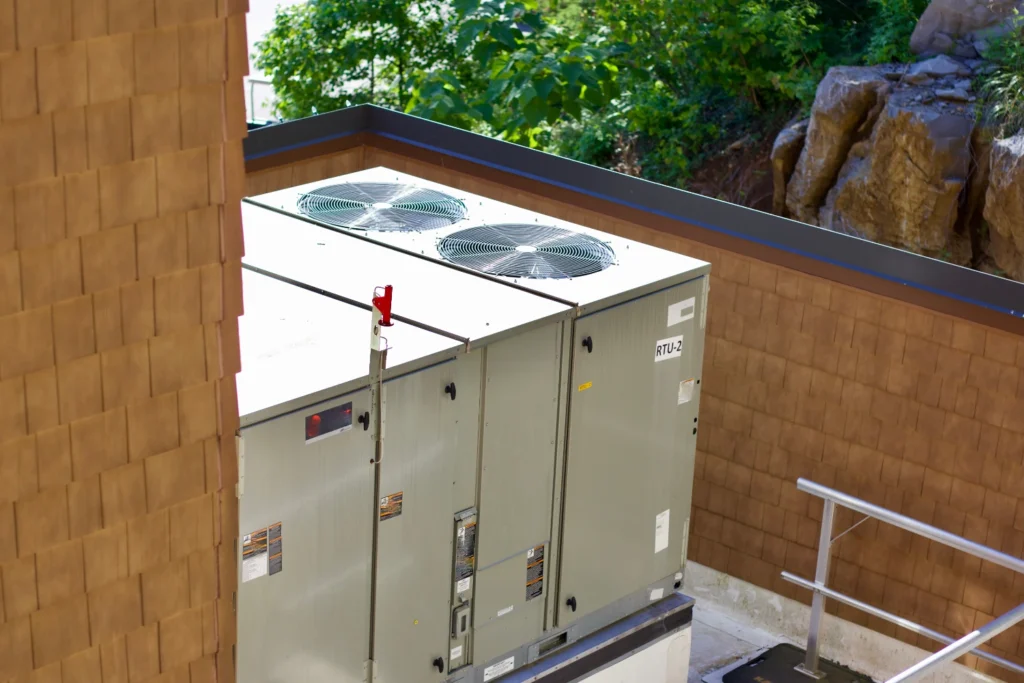
Commercial buildings run packaged units, which here means rooftop HVAC systems. A packaged rooftop unit, or RTU, holds the compressor, condenser, evaporator, blower, filters, and economizer in one cabinet on a roof curb, typically five to thirty-plus tons on three-phase power. Larger facilities move into chillers, boilers, cooling towers, and air handlers.
The RTU vs split question is about the building, not preference. Rooftop units dominate here because flat roofs make natural platforms, roof placement preserves leasable floor space, service happens without disrupting occupants, and a failed unit can be craned off and replaced on the existing curb in a day.
Sizing, Airflow and Zoning Are Calculated Differently
Residential HVAC sizing follows ACCA Manuals J, S, and D. It is a single-zone problem with one occupancy assumption. Commercial design has to account for occupancy that changes hourly, heat from lighting and equipment, the outside air requirement above, and zones that never peak together, all against much higher static pressure.
HVAC zoning is where they diverge most visibly. A house has one thermostat. A commercial building may have a dozen zones on variable air volume boxes, each with its own setpoint and schedule. That coordination layer is why building automation systems exist and why a facility manager can see a fault before a tenant calls.
Electrical, Refrigerant and Who Can Legally Service It
Residential equipment runs on a single phase. Commercial equipment usually runs three-phase at 460 volts, a materially different safety environment, and a technician who works only on homes is not automatically qualified to open a three-phase disconnect. In Texas, contractors are licensed by the Texas Department of Licensing and Regulation, and classifications distinguish environmental air conditioning from commercial refrigeration work.
Refrigerant rules diverge too. All technicians need EPA Section 608 certification, but appliances holding 50 or more pounds of refrigerant carry leak rate thresholds and recordkeeping duties that fall on the owner. The industry is also mid-transition to A2L refrigerants such as R-454B under the AIM Act, which affects replacement planning.
Maintenance, Repair and Lifespan in West Texas
A home system needs service twice a year plus filter changes. If it fails, the household is uncomfortable, and the repair gets scheduled.
A commercial system needs service quarterly at minimum, and Permian Basin dust argues for more. Blowing caliche loads filters and fouls condenser coils far faster here than in most of the country. A fouled coil loses capacity, raises head pressure, and shortens compressor life, and none of that is visible from inside the building until August. That is why facility operators treat HVAC maintenance agreements as an operating expense rather than a discretionary one.
National averages put residential splits at 12 to 15 years, rooftop units at 15 to 20, and chillers at 20 to 25. Cooling season here runs April into October, so a maintained rooftop unit meets its rated life and an unmaintained one frequently does not.
Choosing the Right HVAC System in Midland, TX
| Feature | Residential HVAC | Commercial HVAC |
|---|---|---|
| Property Type | Homes, duplexes, townhomes | Offices, retail, warehouses, schools, churches, clinics, restaurants |
| Typical Equipment | Split system, ductless mini-split | Rooftop units, chillers, boilers, cooling towers, VAV boxes |
| Cooling Capacity | Roughly 2 to 5 tons | Roughly 5 to 30+ tons per unit |
| Installation | Pad plus interior closet or attic, single-phase | Roof curb set by crane, three-phase |
| Maintenance | Twice yearly plus filter changes | Quarterly minimum, usually under a written agreement |
| Energy Efficiency | Rated by SEER2 and HSPF2 | Rated by EER and IEER, managed building-wide |
| System Complexity | Single zone, mechanical and electrical | Multi-zone, with controls and sequencing |
| Ductwork | Flexible sheet metal, low static pressure | Engineered sheet metal, high static pressure, terminal units |
| Controls and Thermostats | One or two thermostats | Building automation system with scheduling and alarms |
| Lifespan | Roughly 12 to 15 years | Roughly 15 to 20 for RTUs, 20 to 25 for chillers |
| Repair Cost | Lower per event, single system | Higher per event, plus downtime |
| Best Use Cases | Homes with one occupancy pattern | Multiple zones, public occupancy or continuous hours |
What This Looks Like in Midland Buildings
- Offices: HVAC systems for office buildings run multiple rooftop units on zoned distribution. The recurring problem is scheduling, not capacity.
- Retail and convenience stores: HVAC for retail stores handles door traffic, lighting load, and refrigeration rejecting heat onto the sales floor.
- Restaurants, warehouses, schools, and churches: kitchen exhaust, ceiling stratification, and intermittent occupancy with high peak loads.
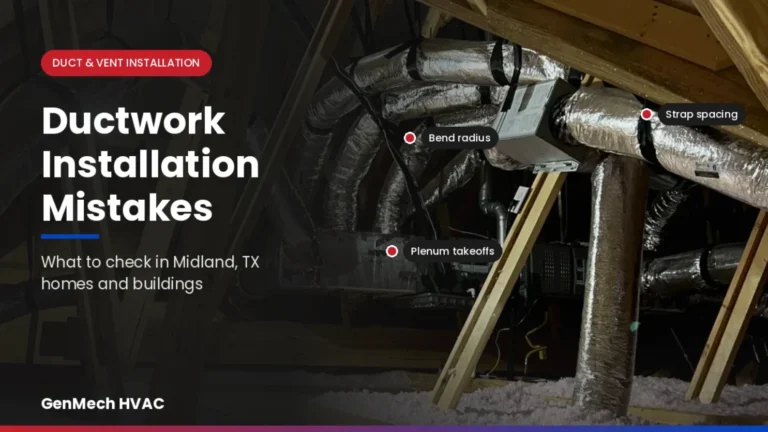
- Homes: Duct integrity decides everything. A leaking return duct in a 130-degree attic pulls superheated air into the system.
Five Mistakes Property Owners Make
- Hiring a residential contractor for commercial equipment.
- Sizing by square footage instead of running a load calculation.
- Ignoring the outside air side, where most commercial energy waste hides.
- Treating filters as housekeeping. Here, filter discipline is compressor protection.
- Replacing like for like without checking the curb and duct.
Frequently Asked Questions
What is the main difference between commercial and residential HVAC systems?
Ventilation. Residential systems recirculate indoor air, while commercial systems must introduce a calculated volume of outdoor air based on occupancy. That single requirement drives the differences in size, airflow, and cost.
Why do commercial buildings in Midland use rooftop units?
Flat roofs make natural platforms, roof placement preserves leasable floor space, service happens without disrupting occupants, and failed units can be craned off and replaced on the existing curb.
How long does an HVAC system last in West Texas?
Residential splits last 12 to 15 years and rooftop units 15 to 20, but local run hours and dust loading compress those numbers. Coil cleaning and filter discipline decide whether a system reaches its rated life.
Which System Is Right for Your Property?
For a single-family home, the answer is nearly always a properly sized split system. For a commercial property, buildings under roughly 20,000 square feet are usually best served by packaged rooftop units, while larger facilities move into chillers, boilers, and central plant equipment. In practice, a load calculation and a walkthrough settle the commercial HVAC vs residential HVAC question in about an hour.
Talk to a Midland HVAC Contractor Who Works on Both
GENMECH HVAC is a veteran-owned, family-operated HVAC and refrigeration contractor based right here in Midland, Texas. We have served Midland, Odessa, Lubbock, San Angelo, and the wider Permian Basin since 2008, with combined technician experience across commercial chillers, boilers, building automation, commercial refrigeration, and residential systems.
Being local is not a marketing line in this business. Our trucks are already in the basin; when a rooftop unit goes down in August, we know how caliche dust behaves on a condenser coil, and we have worked on the buildings your neighbors run. We are certified on Trane, Carrier, York, Daikin, Lennox, Rheem, and Bryant systems. If it has a schematic, we can work on it.
Whether you own a home in Midland or manage a facility across West Texas, call (432) 528-8905. We will look at the building and tell you what it actually needs.