A commercial chiller does not fail all at once. It declines. Efficiency drops a few percentage points. Approach temperatures climb slightly above baseline. A variable frequency drive starts pulling more amps than it should. Zone temperatures drift upward on the hottest afternoons. Each signal is easy to explain away individually. Together, they tell a clear story about a system that is working harder than it needs to because something has shifted inside the refrigerant circuit, the heat exchangers, or the mechanical components that hold the whole plant together.
For facility managers and building engineers in Midland, Texas, reading those signals correctly and acting on them before a minor performance issue becomes a full cooling system failure is one of the highest-value skills you can develop. This post breaks down how commercial chiller diagnostics work, what the most common failure patterns look like across different chiller types, and what separates a professional repair from a temporary fix that puts you back in the same position six months later.
The Difference Between a Chiller Problem and a Cooling System Problem
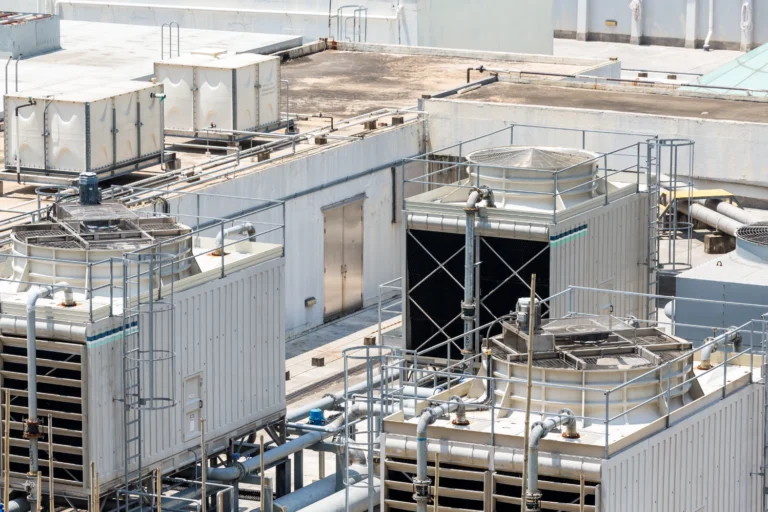
One of the most common mistakes in commercial facility management is treating a chiller issue as isolated equipment trouble when it is actually a symptom of a broader cooling system problem. A chiller does not operate in isolation. It works as part of an interconnected plant that includes chilled water pumps, cooling towers, air handling units, chilled water distribution piping, control valves, and the building automation system that ties all of it together.
When a chiller appears to underperform, the root cause is not always inside the chiller itself. A cooling tower that is not rejecting heat efficiently raises condenser water temperatures, which increases the chiller’s lift and forces the compressor to work harder. Improperly balanced chilled water pumps starve some air handling units while oversupplying others, producing uneven cooling that looks like a chiller capacity problem but is actually a distribution problem. Control valves that have drifted out of calibration send inaccurate load signals to the chiller controls, causing the unit to hunt for a setpoint it cannot hold.
Real cooling system repair starts with a full plant evaluation, not just a look at the chiller. Any technician who diagnoses your chiller without checking the rest of the system is working with incomplete information.
How to Read Your Chiller’s Performance Data Before Calling for Service
Modern commercial chillers log operational data continuously through their onboard controls or through the building automation system. That data is one of the most useful diagnostic tools available, and most facility managers do not use it as actively as they should.
Approach Temperature
Approach temperature measures how closely the refrigerant temperature tracks the water temperature leaving the evaporator or condenser. A well-maintained chiller operating under normal conditions will hold approach temperatures close to its commissioning baseline. When approach temperatures rise, heat transfer is being impeded. Fouled condenser tubes, scaled evaporator plates, or degraded refrigerant charge are the most common causes, and each one points to a different service task.
kW per Ton Efficiency
kW per ton is the standard measure of chiller efficiency. It tells you how much electrical power the chiller is consuming for each ton of cooling it is delivering. As a chiller degrades, this number climbs. Tracking kW per ton over time gives you a quantitative picture of efficiency loss that justifies maintenance spending and supports capital planning conversations with ownership or finance teams.
Superheat and Subcooling
Superheat and subcooling values reflect the condition of the refrigerant circuit. Superheat measures how much the refrigerant vapor has been heated above its boiling point at the evaporator outlet. Subcooling measures how much the liquid refrigerant has been cooled below its condensing point before the expansion device. Both values need to fall within manufacturer-specified ranges for the refrigeration cycle to operate efficiently. Values outside those ranges point to refrigerant charge problems, expansion device faults, or heat exchanger issues that require hands-on diagnosis.
Chiller Types and Why Repair Approaches Differ
Not every commercial chiller responds to the same service approach. The compressor type determines the wear patterns, the diagnostic priorities, and the repair complexity. Getting this wrong means addressing the wrong components and missing the actual problem.
Centrifugal Chiller Repair
Centrifugal chillers are the workhorses of large commercial and industrial facilities. They use a high-speed rotating impeller to compress refrigerant vapor, and their performance depends on precise tolerances between the impeller and the compressor housing. Vibration analysis is the most important diagnostic tool for centrifugal machines. Bearing wear shows up in vibration signatures before it produces any audible change or fault code, which means a technician who is not performing vibration analysis on a centrifugal chiller is missing the most reliable early warning available.
Centrifugal chiller repair also requires specific attention to surge conditions. Surge occurs when the compressor cannot maintain sufficient pressure differential and the refrigerant flow reverses briefly through the impeller. Repeated surge events cause accelerated wear on the impeller and compressor housing and, in severe cases, catastrophic mechanical failure. Surge is usually caused by a low refrigerant charge, high lift conditions from elevated condenser water temperatures, or a compressor operating at part load without proper capacity control through inlet guide vanes or VFD drives.
Screw Chillers
Screw chillers use counter-rotating helical rotors to compress refrigerant. They are more tolerant of variable load conditions than centrifugal machines and are common in facilities with fluctuating cooling demands across the day. The primary wear points are the rotor surfaces and the slide valve that controls capacity modulation. Oil analysis is the most important diagnostic tool for screw chillers because rotor wear shows up as metal contamination in the oil before it affects compressor performance measurably.
Reciprocating and Absorption Chillers
Reciprocating chillers use pistons to compress refrigerant and are typically found in older installations or smaller commercial applications. Valve wear and connecting rod fatigue are the most common failure modes. Absorption chillers use a heat source rather than a compressor to drive the refrigeration cycle and are common in facilities with access to waste heat or natural gas. They have different service requirements entirely, including attention to solution concentration, crystallization risk, and purge unit performance, and they require technicians with specific absorption system training.
Chilled Water System Repair: When the Problem Is in the Distribution
Chilled water system repair addresses failures and performance problems in the piping, pumps, valves, and heat exchangers that make up the distribution side of a chilled water plant. These problems are distinct from chiller compressor or refrigerant issues, but they produce similar symptoms and are frequently misattributed to the chiller itself.
Common chilled water system repair needs in Midland commercial facilities include pump cavitation from improper system pressure, control valve failures that prevent individual air handling units from receiving the correct chilled water flow, fouled plate heat exchangers that reduce heat transfer between the primary and secondary chilled water loops, and insulation failures on chilled water distribution piping that cause the water to gain heat before it reaches the air handling units.
Thermal performance testing across the distribution system identifies where heat gain is occurring and where flow rates are not matching design specifications. Flow verification at each air handling unit confirms that the distribution system is delivering chilled water where it is needed at the right temperatures and pressures. These are systematic diagnostic steps, not guesswork, and they require technicians who understand hydraulic balancing and heat transfer, not just refrigerant service.
What Separates a Real Repair From a Temporary Fix
The most common shortcut in commercial chiller service is refrigerant top-off without leak detection. A chiller low on refrigerant is showing you that refrigerant has left the system somewhere. Adding refrigerant restores short-term performance, but the leak continues. Refrigerant loss accelerates. The next top-off is needed sooner. Eventually the refrigerant loss reaches a point where the compressor is running without adequate lubrication, and the repair cost is exponentially higher than finding and fixing the leak would have been on the first service call.
A proper repair includes leak detection using electronic leak detectors or UV dye tracing, identification and repair of the leak point, verification that no other leak sites are present, and a full refrigerant charge analysis to confirm the system is operating at the manufacturer’s specified charge weight before the technician leaves the job.
The same principle applies to fault isolation in controls and sensor calibration. Clearing a fault code and confirming the chiller restarts is not a repair. Understanding what condition produced the fault, verifying that the sensor or control component generating the alarm is reading accurately, and confirming that the operating condition that caused the fault has been corrected is a repair. The difference between those two outcomes determines whether the problem comes back next week or stays fixed.
Serving Commercial and Industrial Chiller Plants Across the Permian Basin
GENMECH HVAC has worked on commercial and industrial chiller plants in West Texas since 2008. The team handles centrifugal, screw, reciprocating, and absorption systems across Midland, Odessa, Lubbock, and San Angelo, with the diagnostic depth to identify whether the problem is in the chiller itself or in the broader chilled water plant. If your facility is showing early signs of chiller performance decline or you are dealing with an active cooling problem, reach out to schedule a system evaluation.
Call (432) 528-8905 or contact us online to schedule your chiller repair or diagnostic assessment in Midland, TX.